Aerial trams connecting New York City to Roosevelt Island are going to be back in operation next month. But will enough people want to ride these "sky bubbles" over the East River?


The trams have been out of service for seven months, but major renovations have improved their safety and reliability.
"The original trams - chunky red metal on the bottom half, sliding windows above - were perfect relics of mid-1970s design. Each hanging from a brightly painted arm and emblazoned with bold sans-serif type, the trams looked, more or less, like cheerful flying buses. They ran on the equivalent of a clothesline - a single loop of wire with a vehicle at each end. If one got stuck, the other got stuck, too.
The new trams, which are receiving their finishing touches in the Roosevelt Island terminal, suggest the sleek glass-and-steel towers that ate Manhattan (and parts of Brooklyn and Queens) during the last real estate boom. Boarding one is like walking into the achingly spare living room in the sales office of some new Richard Meier project."
Read the full story: Roosevelt Island’s Flying Buses to Return Soon
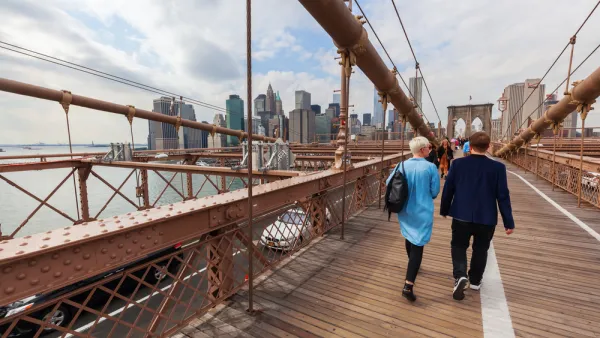
First New Bridge to Manhattan in Decades Proposed Just for Pedestrians and People on Bikes
Introducing the proposed Queens Ribbon Bridge, a $100 million idea to connect Manhattan to Long Island City in Queens, by way of Roosevelt Island.
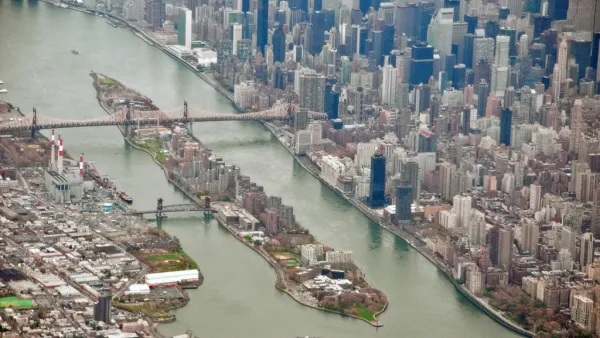
Roosevelt Island's Pneumatic Garbage System
On New York City's Roosevelt Island, residents have long lived free from the roar of garbage trucks. Instead they use Avacs, an island-wide system of pneumatic tubes that moves trash to a central location for processing.
Learning from New York City's Economic Development Engine
Since 2012, New York City has implemented its vision for economic development through NYCEDC, a non-profit corporation charged with deploying city assets to stimulate economic growth.

Planetizen Federal Action Tracker
A weekly monitor of how Trump’s orders and actions are impacting planners and planning in America.

California plans to bury El Niño’s downpour
If the state plays its cards right, it may be able to store a billion acre-feet of El Niño’s water in aquifers.

Desperate measures: Advocates weigh draining Lake Powell to fill Colorado River
Draining the reservoir could reduce evaporation losses by a couple hundred thousand acre-feet.

Housing is the top priority of Seattle’s sole new councilmember
Jenks campaigned on building 1,000 new units of affordable housing.

New tax cuts may slash $1.5 billion in funding for Miami transit, public parks
Amendment 3 will save Miami-Dade homeowners $2,700 in 2028.

Arizona, Wisconsin, Pennsylvania hope to finally advance climate goals post-midterms
The three states have spent years under Republican or divided control.

FREE Course: Walkable City 1: Why Walkability?
After describing his path towards focusing on walkability as the essence of good planning, Jeff Speck marches through his five principal reasons for making more walkable places.
Reinventing Malls: Planning Alchemy—Turning Gray Fields Into Gold
The course focuses on the opportunities and imperatives that shape reinvention of mall sites.

City of Rosemead
Rutgers University, Edward J. Bloustein School of Planning and Public Policy
One Hundred Miles
University of Michigan School for Environment and Sustainability (SEAS)
Hunter College, City University of New York (CUNY)
The Architects Foundation
City of Cambridge
Montrose County
The Pocatello Development Authority