The city of Richmond, Virginia, is hoping to undo years of downtown driving confusion and congestion by converting its web of one-way streets into two-way streets.


Some planners there see the street conversion as the crucial element in implementing the city's recently adopted downtown master plan.
"Richmond is poised to take a much bigger step that promises to transform the neighborhoods around the convention center, making them easier to navigate by car and much friendlier to people on foot or bicycle. The city is about to hire a consultant to determine the most efficient way to reverse the web of one-way streets that have made downtown Richmond a puzzle for anyone trying to reach a destination that's in plain sight.
'It's so hard to get around downtown,' said Charles W. Finley, president of the Historic Jackson Ward Association, which represents the neighborhood that the city hopes will blossom around the convention center."
Read the full story: Richmond plans conversion of one-way streets downtown
Two-Way Streets Coming Soon to Dallas' Victory Park
The city of Dallas got the memo about the benefits of converting one-way streets to two-ways. Two streets in the Victory Park neighborhood will be reconfigured this weekend.
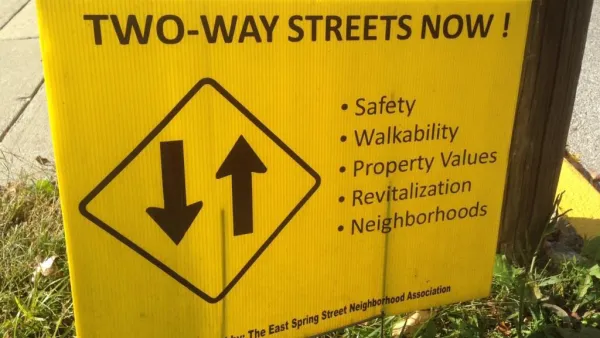
'Two-Ways' to Fix Our Neighborhoods
Expanding on earlier research about the impacts of one-way streets on outcomes such as public health and property values, a new study examines a citywide case study in Louisville.
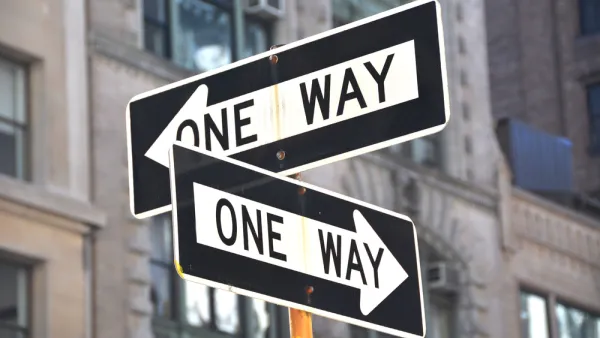
Downtown Denver Converts 18th Street to Two-Way Traffic
Efforts to reshape Downtown Denver to complement the recently re-opened Union Station have now taken to the streets.

Planetizen Federal Action Tracker
A weekly monitor of how Trump’s orders and actions are impacting planners and planning in America.

California plans to bury El Niño’s downpour
If the state plays its cards right, it may be able to store a billion acre-feet of El Niño’s water in aquifers.

Desperate measures: Advocates weigh draining Lake Powell to fill Colorado River
Draining the reservoir could reduce evaporation losses by a couple hundred thousand acre-feet.

Los Angeles just elected an urban planner as its mayor
Transportation analysts are optimistic that Raman will be more aggressive in addressing transit issues than Bass.

Mamdani’s pied-à-terre tax survives legal challenge
A panel of judges found that the plaintiffs failed to demonstrate injury as a result of New York City's implementation of the tax.

Eastern Nebraska is running out of electricity
Data centers and electrification are straining eastern Nebraska’s grid, throttling economic development.

FREE Course: Walkable City 1: Why Walkability?
After describing his path towards focusing on walkability as the essence of good planning, Jeff Speck marches through his five principal reasons for making more walkable places.
Reinventing Malls: Planning Alchemy—Turning Gray Fields Into Gold
The course focuses on the opportunities and imperatives that shape reinvention of mall sites.

City of Rosemead
Rutgers University, Edward J. Bloustein School of Planning and Public Policy
One Hundred Miles
University of Michigan School for Environment and Sustainability (SEAS)
Hunter College, City University of New York (CUNY)
The Architects Foundation
City of Cambridge
Montrose County
The Pocatello Development Authority