This post from Citiwire looks at Salt Lake City and the state of Utah as home to some of the most active and progressive planning practitioners.


Writer David Boyd argues that other cities and regions should follow the "Utah Model".
"[W]hat we are seeing is that smart communities, like smart businesses, are using the laggard pace of the present economic downturn to lay the foundation for a high functioning and successful future. By engaging in highly participatory and increasingly regional-scale planning initiatives, these communities are developing the civic infrastructure necessary to succeed in the 21st century.
...Today, Envision Utah continues its work to forge regional agreement over projects such as Blueprint Jordan River, a corridor plan spanning three counties and 15 cities. It has been instrumental in working with the Utah Transit Authority, the region's two metropolitan planning organizations, and numerous cities to plan and develop an extensive system of light rail and bus rapid transit including incentives for transit oriented development efforts along the routes."
Read the full story: The Future of Planning – “Utah Style”

Feds look to Great Salt Lake as a source of rare minerals
A new grant is funding the expansion of non-evaportative lithium extraction from the brackish waters.

‘Snow-eater’ heat waves are increasing in frequency, study finds
During intense spring heatwaves, snow melts nearly twice as fast as usual and can overwhelm city reservoirs.
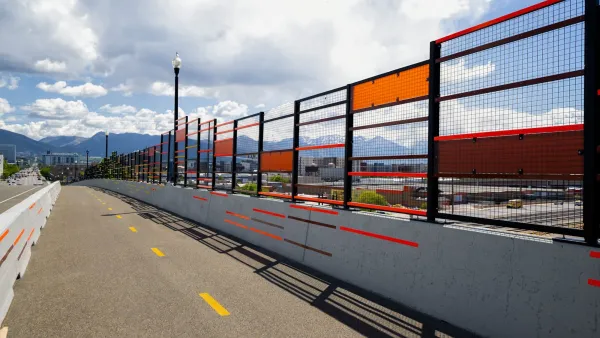
Salt Lake City opens protected bike path on viaduct trail
The 400 South Viaduct Trail features the state's longest continuous piece of public art.

Planetizen Federal Action Tracker
A weekly monitor of how Trump’s orders and actions are impacting planners and planning in America.

California plans to bury El Niño’s downpour
If the state plays its cards right, it may be able to store a billion acre-feet of El Niño’s water in aquifers.

Desperate measures: Advocates weigh draining Lake Powell to fill Colorado River
Draining the reservoir could reduce evaporation losses by a couple hundred thousand acre-feet.

Los Angeles just elected an urban planner as its mayor
Transportation analysts are optimistic that Raman will be more aggressive in addressing transit issues than Bass.

Mamdani’s pied-à-terre tax survives legal challenge
A panel of judges found that the plaintiffs failed to demonstrate injury as a result of New York City's implementation of the tax.

Eastern Nebraska is running out of electricity
Data centers and electrification are straining eastern Nebraska’s grid, throttling economic development.

FREE Course: Walkable City 1: Why Walkability?
After describing his path towards focusing on walkability as the essence of good planning, Jeff Speck marches through his five principal reasons for making more walkable places.
Reinventing Malls: Planning Alchemy—Turning Gray Fields Into Gold
The course focuses on the opportunities and imperatives that shape reinvention of mall sites.

City of Rosemead
Rutgers University, Edward J. Bloustein School of Planning and Public Policy
One Hundred Miles
University of Michigan School for Environment and Sustainability (SEAS)
Hunter College, City University of New York (CUNY)
The Architects Foundation
City of Cambridge
Montrose County
The Pocatello Development Authority