The fishing industry has been in decline for years in Portland, Maine, which is hurting many of the industry-related businesses on the city's waterfront. Local business people see salvation in diversity.


"A group of wharf owners asked for the change, saying they could no longer afford to care for the aging structures with the rents they get from fishermen and their like. The owners point to bleak statistics: landings at Portland's seafood auction, for example, dropped to 6.3 million pounds last year from 17 million in 2006.
'We're only trying to find ways to keep these properties generating revenue,' said Charlie Poole, whose family has owned Union Wharf since the 1800s. 'We can't afford to have a lot of space sitting idle as we wait for fishing to come back.'"
The proposal to bring new kinds of development to the wharf area is expected to go before the city council next month, but some worry that handing the area over to commercial developers will destroy the waterfront's connection to the fishing industry.
Read the full story: In Portland, Me., a New Business Plan
Portland's Unrealized Eastern Waterfront Plans Gain New Momentum
Portland is picking up momentum on fitful long-term planning efforts along the east bank of the Willamette River.
Portland to transform vacant landfill into energy-generating sanctuary
The project will boast hundreds of solar panels, and create jobs in Portland’s renewable energy industry
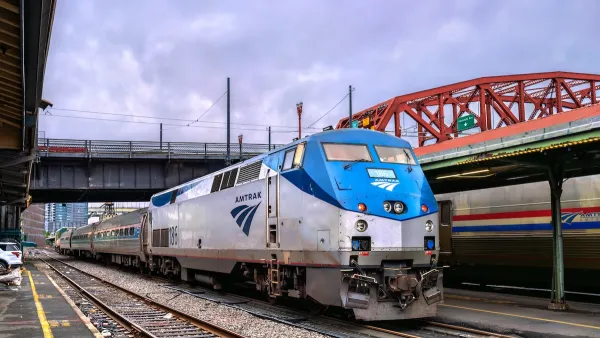
Transit leaders progress high-speed rail from Portland to Vancouver, B.C.
Washington state officials may reveal feasible routes for the high-speed rail in late 2027.

Planetizen Federal Action Tracker
A weekly monitor of how Trump’s orders and actions are impacting planners and planning in America.

California plans to bury El Niño’s downpour
If the state plays its cards right, it may be able to store a billion acre-feet of El Niño’s water in aquifers.

Desperate measures: Advocates weigh draining Lake Powell to fill Colorado River
Draining the reservoir could reduce evaporation losses by a couple hundred thousand acre-feet.

In Texas, data centers are swallowing promised parkland
Residents who moved to Taylor, Texas for a rural community now have to contend with three data centers in their backyard.

How a Chicago-sized wind farm beat the odds and powered on
The project spanned five presidential administrations and a standoff with a U.S. military base.

MTA gives itself 30 days to transform pit into basketball court
The site has been under construction since 2022; the city originally estimated it would finish the court in 2024.

FREE Course: Walkable City 1: Why Walkability?
After describing his path towards focusing on walkability as the essence of good planning, Jeff Speck marches through his five principal reasons for making more walkable places.
Reinventing Malls: Planning Alchemy—Turning Gray Fields Into Gold
The course focuses on the opportunities and imperatives that shape reinvention of mall sites.

City of Rosemead
Rutgers University, Edward J. Bloustein School of Planning and Public Policy
One Hundred Miles
Hunter College, City University of New York (CUNY)
The Architects Foundation
University of Cincinnati Online
City of Cambridge
Montrose County
The Pocatello Development Authority