University of Missouri-Kansas City researchers are making headway on "self-synchronizing moving objects" -- that is, getting cars to communicate with each other on highways so they can travel at faster speeds without accidents.


In an article focused on the latest technology in driverless cars, Vijay Kumar, a professor of computer science at the University of Missouri-Kansas City, explains that his interest lies in taking the idea to a higher level of functionality:
"He wants to go beyond cars that simply avoid crashing, to vehicles whose computers communicate with one another. In his scenario, vehicles will be able to move in harmony, maximizing efficiency and even eliminating the need for traffic lights or other outside controls.
'Initially, a voice-activated system will give commands to the driver,' he said. 'Later, a fully automatic system will be developed in which the driver would not have any role to play.'"
Read the full story: Driverless cars just around the corner
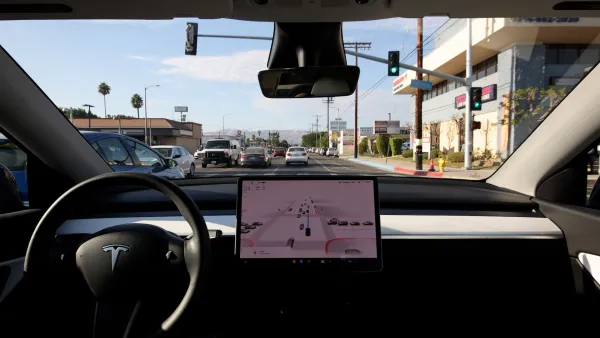
Tesla Launches Unsupervised Robotaxis in Austin
The company has been operating autonomous taxis with human safety drivers in the car in Austin since last June.
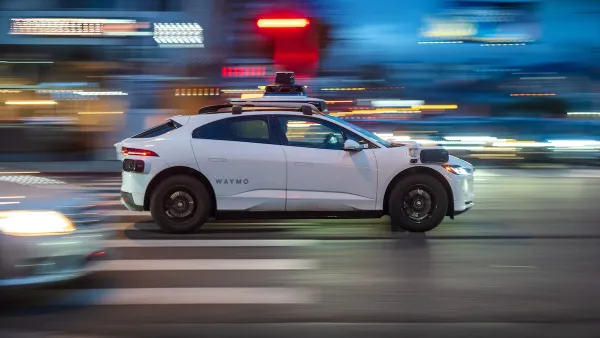
Seattle's Plan for Adopting Driverless Cars
Equity, safety, accessibility and affordability are front of mind as the city prepares for robotaxis and other autonomous vehicles.
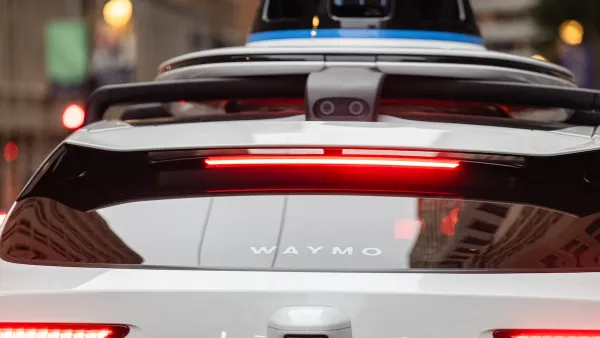
NHTSA Launches Investigations Into Two More Self-Driving Automakers
The federal agency is responding to reports of crashes and erratic behavior from Waymo and Zoox vehicles.

Planetizen Federal Action Tracker
A weekly monitor of how Trump’s orders and actions are impacting planners and planning in America.

California plans to bury El Niño’s downpour
If the state plays its cards right, it may be able to store a billion acre-feet of El Niño’s water in aquifers.

Desperate measures: Advocates weigh draining Lake Powell to fill Colorado River
Draining the reservoir could reduce evaporation losses by a couple hundred thousand acre-feet.

Los Angeles just elected an urban planner as its mayor
Transportation analysts are optimistic that Raman will be more aggressive in addressing transit issues than Bass.

Mamdani’s pied-à-terre tax survives legal challenge
A panel of judges found that the plaintiffs failed to demonstrate injury as a result of New York City's implementation of the tax.

Eastern Nebraska is running out of electricity
Data centers and electrification are straining eastern Nebraska’s grid, throttling economic development.

FREE Course: Walkable City 1: Why Walkability?
After describing his path towards focusing on walkability as the essence of good planning, Jeff Speck marches through his five principal reasons for making more walkable places.
Reinventing Malls: Planning Alchemy—Turning Gray Fields Into Gold
The course focuses on the opportunities and imperatives that shape reinvention of mall sites.

City of Rosemead
Rutgers University, Edward J. Bloustein School of Planning and Public Policy
One Hundred Miles
University of Michigan School for Environment and Sustainability (SEAS)
Hunter College, City University of New York (CUNY)
The Architects Foundation
City of Cambridge
Montrose County
The Pocatello Development Authority