Safe, reliable, affordable and sustainable public transport options could be integral in addressing inequality in Latin America.


Last week, the United Nations Development Program (UNDP) released its first Human Development Report for Latin America and the Caribbean (LAC). The report, Acting On The Future: Breaking The Intergenerational Cycle Of Inequality (PDF in Spanish), focuses on policies that could help Latin America - the most unequal region in the world - escape from the inequality trap.
The report introduces a new indicator to measure human development while reflecting inequality, and it finds that the region's Human Development Index would fall by between 6 and 19 percent, on average, if it were corrected to account for inequality.
Acknowledging that poverty reduction programs in the region have too often focused on specific, piece-meal solutions, rather than addressing the deep-seated roots of poverty and inequality, the report calls for more comprehensive public social policies across the region.
Thanks to Garrett Bradford
Read the full story: Transport and Inequality in Latin America and the Caribbean
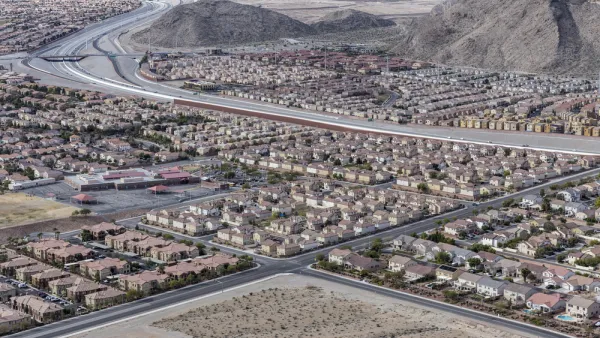
Research: Sprawl Linked to Poverty
Low-income families living in high-sprawl neighborhoods are limited in their access to education, jobs, and other amenities, often trapping them in a cycle of poverty.
Wayfinding Symbols Across the World
Metro stations, train stations and streetcar systems have distinct ways of showing how to get from one area to another. TheCityFix's Jonna McKone looks at mass transit systems from Mexico City to Paris and the visual representations used in each one.
Accessibility Vs. Mobility Redux
I’m going to riff off a recent Interchange Blog post by Michael Lewyn on the relationship between mobility and accessibility. Given the positive comments from the planning community to Michael’s post, a little engagement may be necessary for both clarity as well as fully understanding the implications of reading too much into the accessibility versus mobility debate.

Planetizen Federal Action Tracker
A weekly monitor of how Trump’s orders and actions are impacting planners and planning in America.

California plans to bury El Niño’s downpour
If the state plays its cards right, it may be able to store a billion acre-feet of El Niño’s water in aquifers.

Desperate measures: Advocates weigh draining Lake Powell to fill Colorado River
Draining the reservoir could reduce evaporation losses by a couple hundred thousand acre-feet.

Chicago voters approve permanent festival grounds, penalty for vacant property owners
Currently, major summer and fall festivals take over public parks for weeks at a time, drawing criticism from nearby residents

NYC votes to cut outdoor dining red tape, speed up permitting
New York City also voted to allow the Department of Transportation to begin work on urgent projects before notifying elected officials.

California appears to reject Prop. 45
The proposition would have expanded the projects that qualify for a streamlined environmental review, effectively paring down the California Environmental Quality Act.

FREE Course: Walkable City 1: Why Walkability?
After describing his path towards focusing on walkability as the essence of good planning, Jeff Speck marches through his five principal reasons for making more walkable places.
Reinventing Malls: Planning Alchemy—Turning Gray Fields Into Gold
The course focuses on the opportunities and imperatives that shape reinvention of mall sites.

City of Rosemead
Rutgers University, Edward J. Bloustein School of Planning and Public Policy
One Hundred Miles
Hunter College, City University of New York (CUNY)
The Architects Foundation
University of Cincinnati Online
City of Cambridge
Montrose County
The Pocatello Development Authority