San Francisco has always been home to utopian dreamers. With a clean slate to work on in the middle of the bay, the city has drafted plans for a sustainable utopia. With politics and money kicking in, will the dream be dashed?


Writer Jeremy Adam Smith reflects on the history of utopian planned cities, from Ebenezer Howard's Garden City to architectural eco-villages in China. Will the Treasure Island plan go the way of those well-intentioned ideas, or could it be built as planned?
"...Treasure Island is in some ways quite different from those projects. Its commitments to stormwater wetlands and clean energy are legally binding, unlike in China. And unlike the Chinese projects - or, for that matter, Stevenage - the Treasure Island redevelopment has been subjected to 15 years of intense expert scrutiny and public involvement. During a recent trip to Treasure Island, I saw signs everywhere advertising meetings for residents to give feedback on the project. When I asked one two-year resident if he'd had a chance to make his voice heard, he just laughed. 'I've had too much opportunity!' he said. 'I'm sick of hearing about it!'"
Other voices heard in the story are very concerned that Treasure Island is basically landfill, making it susceptible to earthquakes and flooding due to climate change.
Read the full story: Can a City Build a Better Version of Itself?

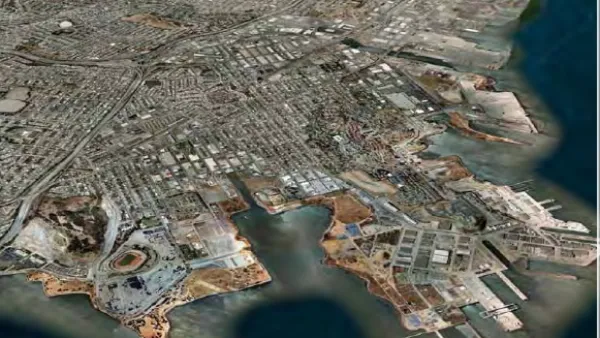
S.F. Bay Area Megaprojects Not Coming to Fruition
Plans for numerous large-scale developments in the region mean thousands of housing units should be on the way, but constant delays and setbacks have left projects nowhere near completion.
California's Business-Friendly, Bipartisan Approach to Climate Change
Gov. Jerry Brown, accompanied by former Gov. Arnold Schwarzenegger, signed legislation to continue the cap-and-trade program initially authorized under a bill signed by his Republican predecessor 11 years ago at the same Treasure Island location.
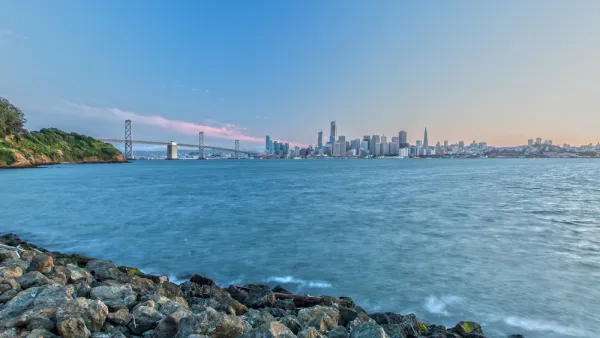
An Expanding Vision for San Francisco's Treasure Island
San Francisco is starved for ideas for ways to meet growing demand for housing, and skyrocketing prices. Here's a big idea: how about building space for some 20,000 new residents on Treasure Island, located in the middle of the bay?

Planetizen Federal Action Tracker
A weekly monitor of how Trump’s orders and actions are impacting planners and planning in America.

California plans to bury El Niño’s downpour
If the state plays its cards right, it may be able to store a billion acre-feet of El Niño’s water in aquifers.

Chicago breaks ground on $3 billion megadevelopment
The new neighborhood, titled Foundry Park, will one day host 3,700 residences.

California High-Speed Rail Authority CEO resigns after $600,000 scandal
Under Ian Choudri, the authority used taxpayer dollars to fund first class flights and trips to nightclubs.

Want to study the Missouri River? Soon, you may need unanimous approval from 10 states
Legislation would require 10 governors’ permission to study or build projects moving water outside the basin.

Desperate measures: Advocates weigh draining Lake Powell to fill Colorado River
Draining the reservoir could reduce evaporation losses by a couple hundred thousand acre-feet.

FREE Course: Walkable City 1: Why Walkability?
After describing his path towards focusing on walkability as the essence of good planning, Jeff Speck marches through his five principal reasons for making more walkable places.
Reinventing Malls: Planning Alchemy—Turning Gray Fields Into Gold
The course focuses on the opportunities and imperatives that shape reinvention of mall sites.

City of Rosemead
Rutgers University, Edward J. Bloustein School of Planning and Public Policy
One Hundred Miles
Hunter College, City University of New York (CUNY)
The Architects Foundation
University of Cincinnati Online
City of Cambridge
Montrose County
The Pocatello Development Authority