In an effort to regain its stature as a center of culture, Cairo is looking at plans to re-integrate the pedestrian into its now car-dominated downtown.


Officials there want to turn downtown Cairo into a walkable tourist area. One idea: ban cars.
"Cairo drivers are used to having it all their own way with the ability to go everywhere and anywhere they please, but the government is trying to imitate historical pedestrian areas in European capitals as a means of restoring the city's lost glory.
Even for those who are freshly acquainted with Cairo's congested heart, it's impossible not to feel that Downtown lives in the shadow of its former self. Created by Khedive Ismail Pasha, in the latter half of the nineteenth century to be a Nile-side imitation of Paris with wide boulevards and spacious squares, the belle époque architecture now crumbles onto sidewalks lined with gaudy, neon-lit storefronts and streets deafened by the crawling mass of honking traffic."
Read the full story: Downtown Cairo’s Extreme Makeover

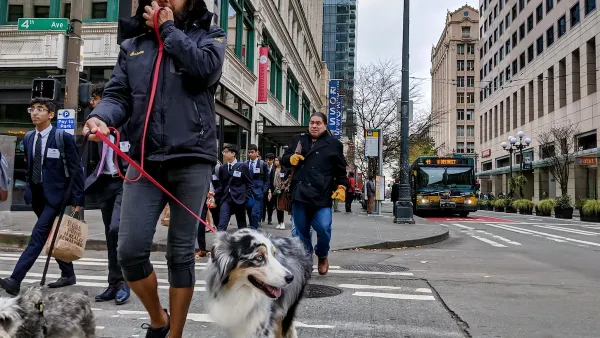
Now 20% Car-Free, Seattle's Population is Growing. Its Traffic is Not.
Since 2017, the number of cars in the city has stayed roughly the same, even as the population continues to grow.

Study: Automobile Dependency Reduces Life Satisfaction
Automobile dependency has negative implications for wellbeing. This academic study finds that relying on a car for more than 50 percent of out-of-home travel is associated with significant reductions in life satisfaction.

When States Hinder Local Efforts to Cut Down on Cars
Reducing car dependency is a vital climate goal. Many U.S. cities want to shift trips to other modes, but they're often held back by state governments.

Planetizen Federal Action Tracker
A weekly monitor of how Trump’s orders and actions are impacting planners and planning in America.

Amtrak, CN end decades-long dispute with eight-year agreement
The new operating agreement establishes an updated framework for the companies to work together, including processes to resolve disputes.

Judges permit Denver to divert 77,000 acre feet from the Colorado River for reservoir expansion
Overuse and climate change have caused the Colorado River’s water levels to plummet.

NYC DOT wants faster, more permanent street upgrades
The city is examining ways to build more concrete infrastructure without getting entangled in 'decades-long' projects.

'Something we’ve never seen before:' rising utility rates could strain city finances nationwide
Data centers, climate change and other factors have caused utility rates in the United States to increase by 38% since 2020.

Trump to overrule local leaders, lease millions of acres of America’s Pacific Island territories’ seafloors to mining companies
International law says that the Indigenous people of America’s territories have a right to prior and informed consent regarding projects that impact their countries.

FREE Course: Walkable City 1: Why Walkability?
After describing his path towards focusing on walkability as the essence of good planning, Jeff Speck marches through his five principal reasons for making more walkable places.
Reinventing Malls: Planning Alchemy—Turning Gray Fields Into Gold
The course focuses on the opportunities and imperatives that shape reinvention of mall sites.

Harvard University Graduate School of Design
KFH Group Inc.
Greater Baltimore Committee
The Architects Foundation
University of Cincinnati Online
The Pocatello Development Authority
The Urban Renewal Agency of the City of Pocatello