A historic Navy yard in Brooklyn has been crumbling for decades. Now a deal has been struck to redevelop part of the area. But even with preservation efforts, many of the area's historic homes may be too damaged to save.


"For more than three decades, Admiral's Row, like much of the nearby industrial waterfront, was largely left to rot. Further complicating matters was the fact that even though much of the 300-acre site was turned over to New York City in 1966, 10 former officers' homes and a timber shed that was once used to repair masts of large sailing vessels remained under the control of the federal government.
For decades, both sites languished.
The roofs on some of the old naval officers' homes, built from 1864 to 1901, collapsed long ago as weeds and vines took up residence. Meanwhile the storied Navy Yard - where 11,000 Colonial patriots lost their lives aboard British prison ships during the Revolution; where the Union outfitted ships to battle the Confederacy; and where the Navy established its radio command center for the North Atlantic Fleet during World War II - became synonymous with corruption and urban blight."
The new $60 million development plan will bring in a new grocery store, and try to salvage some of the homes on Admiral's Row. The set of homes has been largely ignored in the past, despite more than 40 preservation efforts underway in the Navy yard.
Read the full story: The Struggle to Preserve the Brooklyn Navy Yard

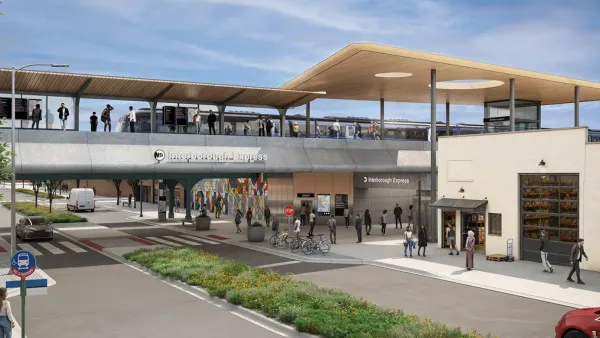
NYC releases new renderings for $5.5 billion Interborough Express
The slated stations will have a modern look, enhanced lighting and improved audio announcements.
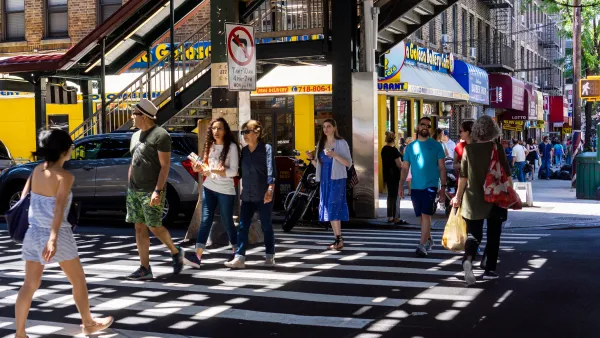
NYC needs 700,000 new homes to resolve housing crisis, report states
The report gave every neighborhood a non-binding development target.
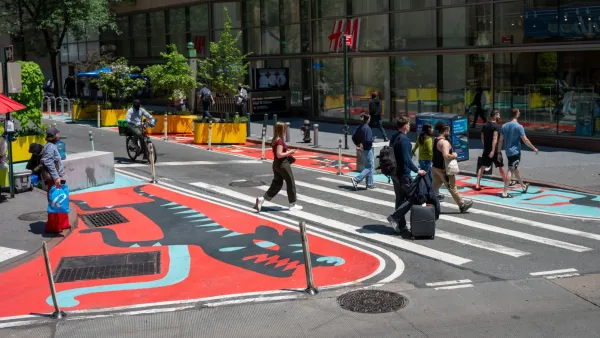
See Downtown Brooklyn’s Dramatic Complete Streets Transformation
A streetscape redesign spearheaded by the Downtown Brooklyn Partnership has quickly made many of Brooklyn’s streets unrecognizable.

Planetizen Federal Action Tracker
A weekly monitor of how Trump’s orders and actions are impacting planners and planning in America.

The state-sanctioned urbicide of Austin
People don’t kill cities. Freeways do.

Colorado’s Largest Data Center Could Rise Next to Homes — Without a Public Hearing
The proposed campus would consume 11 times the power of Denver International Airport; as it has across the country, opposition mounts.

Judges permit Denver to divert 77,000 acre feet from the Colorado River for reservoir expansion
Overuse and climate change have caused the Colorado River’s water levels to plummet.

Amtrak, CN end decades-long dispute with eight-year agreement
The new operating agreement establishes an updated framework for the companies to work together, including processes to resolve disputes.

Raised interest rates may kill financially vulnerable construction projects
The chief economist at ConstructConnect warns that if construction project owners are negatively impacted by the raised rates, it could result in delayed payments to contractors.

FREE Course: Walkable City 1: Why Walkability?
After describing his path towards focusing on walkability as the essence of good planning, Jeff Speck marches through his five principal reasons for making more walkable places.
Reinventing Malls: Planning Alchemy—Turning Gray Fields Into Gold
The course focuses on the opportunities and imperatives that shape reinvention of mall sites.

Greater Baltimore Committee
Eagle County Government
Harvard University Graduate School of Design
The Architects Foundation
University of Cincinnati Online
The Pocatello Development Authority
The Urban Renewal Agency of the City of Pocatello
Journal of the American Planning Association