Tysons Corner, Virginia, represents an unlikely pilot project for "desprawling" America's suburbs, but the expansion of Metro rail through the town has been seized by local officials as an opportunity to revamp the city's urban form and density.


"It's hard to conceive of a less likely poster child for the livable-communities movement, which prizes dense urban-style neighborhoods where residents can live without cars. But Fairfax County is close to finalizing a radical multibillion-dollar plan to 'desprawl' Tysons by tearing up large swaths of the existing town and planning a series of urban villages with buildings up to 25 stories high. The idea, developed by local and county leaders over the last few years, is to bring 100,000 new residents to town and pack them together, transporting the texture and energy of city life to the exurbs.
Livability experts are understandably fascinated with the plan. 'Tysons Corner is a leading example of a suburb trying to transform itself into something else,' says Christopher Leinberger, a visiting fellow at the Brookings Institution and a leading thinker on the future of America's suburbs. 'The people there see walkable urban areas and say, ‘We want that here.' They want that kind of urban excitement.'"
Jebediah Reed reports that when the Washington D.C. area Metro system expands through Tysons Corner, each of the four stations in the city will anchor new urban villages.
Read the full story: The Great Desprawling Experiment
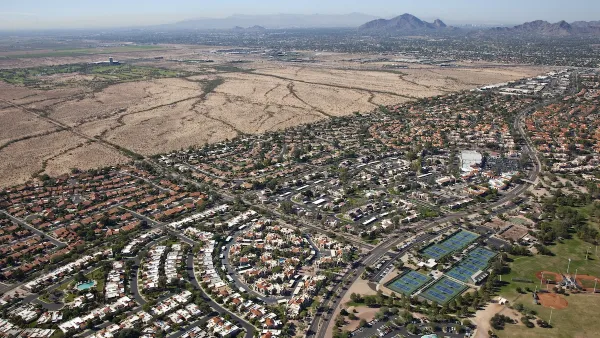
Nearly Half a Million New Arizona Homes Halted Due to Water Crisis
The Arizona Department of Water Resources has put a moratorium on new water supply permits, making the future of planned residential developments uncertain.
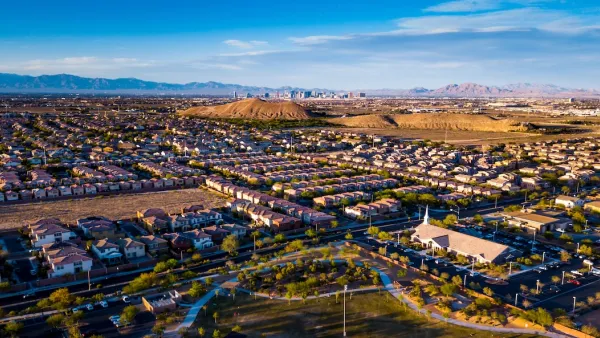
The Nation’s 40 Fastest-Growing Suburbs
Projected population growth will be concentrated in suburban communities around major metropolitan areas, with the Sunbelt experiencing the fastest growth.

The Natalist Case For Sprawl (And Why It Fails)
Some commentators defend anti-urban government policies such as exclusionary zoning on the basis that homeowning suburbanites have high birth rates. But this doesn't seem to be true in recent decades.

Planetizen Federal Action Tracker
A weekly monitor of how Trump’s orders and actions are impacting planners and planning in America.

Eastern Nebraska is running out of electricity
Data centers and electrification are straining eastern Nebraska’s grid, throttling economic development.

Study reveals best places in the U.S. for cycling, walking
New research from Streetlight Data examines bicycle and pedestrian miles per capita in the 100 largest U.S. cities by population.

San Antonio is using environmental review to stall ICE detention center
San Antonio sued last month to pause work on the new detention center until the federal government studied its effect on the surrounding area.

Austin plans light rail extension — before breaking ground on light rail
The planned extension is three miles long and will take riders straight to Austin-Bergstrom International Airport.

Chicago cuts ribbon on $300,000, self-cleaning public toilet
The public toilet is the city’s first, and may pave the way for a rollout of similar facilities.

FREE Course: Walkable City 1: Why Walkability?
After describing his path towards focusing on walkability as the essence of good planning, Jeff Speck marches through his five principal reasons for making more walkable places.
Reinventing Malls: Planning Alchemy—Turning Gray Fields Into Gold
The course focuses on the opportunities and imperatives that shape reinvention of mall sites.

City of Charlotte
City of Rosemead
Rutgers University, Edward J. Bloustein School of Planning and Public Policy
University of Michigan School for Environment and Sustainability (SEAS)
Hunter College, City University of New York (CUNY)
The Architects Foundation
City of Cambridge
The Pocatello Development Authority
The Urban Renewal Agency of the City of Pocatello