Nearly five years after Hurricane Katrina devastated New Orleans, the bungled recovery effort offers lessons to Haiti and Chile as they recover from more recent natural disasters, according to this piece from Allison Arieff.


"There will be a similar lack of expediency in Haiti, but at this still-early stage there's still time to apply some of the lessons we learned from the missteps following Katrina. The widespread destruction in New Orleans (and Biloxi, Miss.) starkly highlighted the need for context-specific building codes, stable construction and non-toxic materials. One has only to look at the fatalities in Chile as compared to Haiti: though the Chilean earthquake registered 8.8 on the Richter scale, the country experienced 279 fatalities, compared to Haiti's 230,000 from their less powerful 7.0 earthquake. (Another reason for the difference, of course, had to do with where and how the two earthquakes struck.)"
Arieff calls for a context-driven architectural response to the disaster in Haiti, rather than one based on specific design aesthetics that may overshadow the true purpose of the recovery effort.
Read the full story: Rebuilding in Haiti

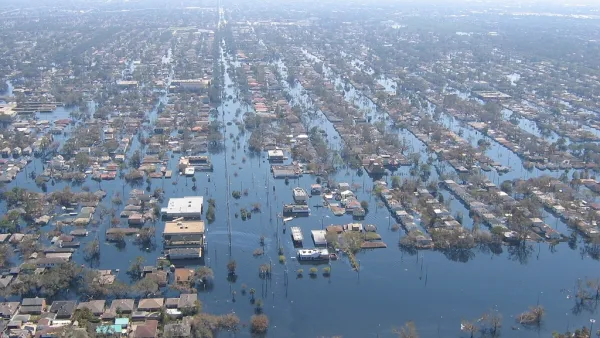
New Flood Maps Downplay Risks in New Orleans
Recently released flood maps created by FEMA for the city of New Orleans are receiving criticism for being 'overly optimistic' when it comes to risks posed by hurricanes and rising sea levels.
Slow Progress in East New Orleans
In this piece from Places, Deborah Gans offers a firsthand look at planning for recovery in the city's neglected East side.
Decentralizing Decisionmaking in New Orleans' Recovery
Various plans and strategies have been crafted over the years to try to help New Orleans recover from the devastation of Hurricane Katrina. While early plans took a stronger stance, the city is now taking a less heavy-handed approach.

Planetizen Federal Action Tracker
A weekly monitor of how Trump’s orders and actions are impacting planners and planning in America.

Amtrak, CN end decades-long dispute with eight-year agreement
The new operating agreement establishes an updated framework for the companies to work together, including processes to resolve disputes.

Judges permit Denver to divert 77,000 acre feet from the Colorado River for reservoir expansion
Overuse and climate change have caused the Colorado River’s water levels to plummet.

NYC DOT wants faster, more permanent street upgrades
The city is examining ways to build more concrete infrastructure without getting entangled in 'decades-long' projects.

'Something we’ve never seen before:' rising utility rates could strain city finances nationwide
Data centers, climate change and other factors have caused utility rates in the United States to increase by 38% since 2020.

Trump to overrule local leaders, lease millions of acres of America’s Pacific Island territories’ seafloors to mining companies
International law says that the Indigenous people of America’s territories have a right to prior and informed consent regarding projects that impact their countries.

FREE Course: Walkable City 1: Why Walkability?
After describing his path towards focusing on walkability as the essence of good planning, Jeff Speck marches through his five principal reasons for making more walkable places.
Reinventing Malls: Planning Alchemy—Turning Gray Fields Into Gold
The course focuses on the opportunities and imperatives that shape reinvention of mall sites.

Harvard University Graduate School of Design
KFH Group Inc.
Greater Baltimore Committee
The Architects Foundation
University of Cincinnati Online
The Pocatello Development Authority
The Urban Renewal Agency of the City of Pocatello