That's what citizen groups are calling digital billboards, saying they area a safety hazard for distracting drivers. States around the country are grappling with how to regulate the glowing signs.


So far, about 2,000 of the U.S.'s 450,000 billboards have gone digital. The industry hopes to convert many more, because they bring in a much greater profit. But there is a growing concern that the signs are intrusive and dangerous.
From the New York Times: "Abby Dart, executive director of Scenic Michigan, a nonprofit group trying to block construction of new digital billboards in the state, calls the signs 'weapons of mass distraction' and says they can be more dangerous than phones.
'You can turn off your phone,' she said. 'The billboard gets your attention whether you want to give it or not.'"
Read the full story: Digital Billboards, Diversions Drivers Can’t Escape
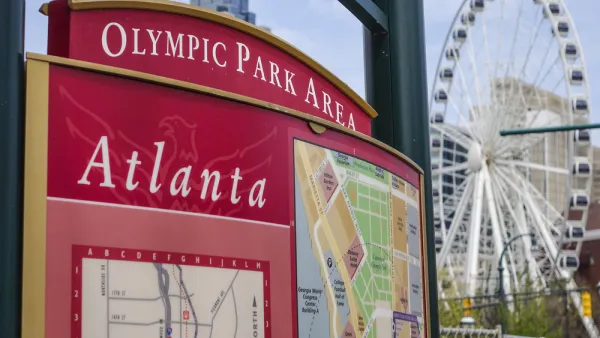
Atlanta to Create New Downtown Sign District
Not everybody has the same definition of vibrant, but Atlanta recently chose the way of Times Square and the Sunset Strip.
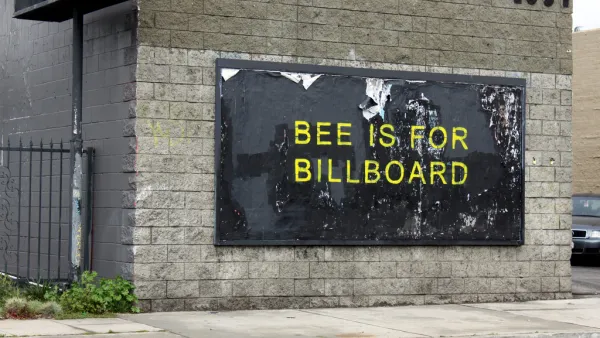
Artists Find Alternate Uses for Billboards in Los Angeles
With a surplus of unsold billboard spaces dotting Los Angeles, artists are using the empty spaces as canvasses for new forms of public art.
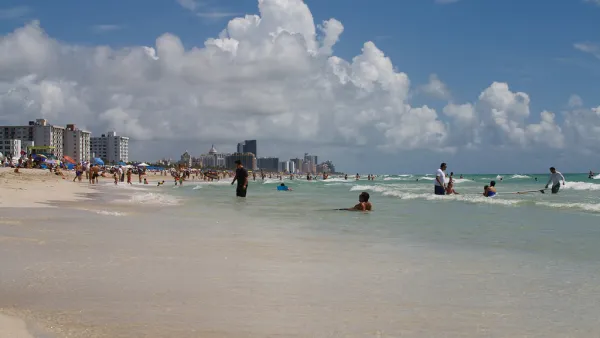
Miami Beach's Floating Billboards: A Nuisance on Water
The picturesque ocean front of Miami Beach is being sullied by digital billboards now floating off shore on boats, outside the reach of the city's authority.

Planetizen Federal Action Tracker
A weekly monitor of how Trump’s orders and actions are impacting planners and planning in America.

California plans to bury El Niño’s downpour
If the state plays its cards right, it may be able to store a billion acre-feet of El Niño’s water in aquifers.

Desperate measures: Advocates weigh draining Lake Powell to fill Colorado River
Draining the reservoir could reduce evaporation losses by a couple hundred thousand acre-feet.

Mamdani’s pied-à-terre tax survives legal challenge
A panel of judges found that the plaintiffs failed to demonstrate injury as a result of New York City's implementation of the tax.

Eastern Nebraska is running out of electricity
Data centers and electrification are straining eastern Nebraska’s grid, throttling economic development.

Seattle passes record-breaking transit services expansion
Proposition 1 will double the city’s transit tax to add 95,000 more bus trips and preserve 180,000 bus trips annually.

FREE Course: Walkable City 1: Why Walkability?
After describing his path towards focusing on walkability as the essence of good planning, Jeff Speck marches through his five principal reasons for making more walkable places.
Reinventing Malls: Planning Alchemy—Turning Gray Fields Into Gold
The course focuses on the opportunities and imperatives that shape reinvention of mall sites.

City of Rosemead
Rutgers University, Edward J. Bloustein School of Planning and Public Policy
One Hundred Miles
University of Michigan School for Environment and Sustainability (SEAS)
Hunter College, City University of New York (CUNY)
The Architects Foundation
City of Cambridge
Montrose County
The Pocatello Development Authority