Not everybody has the same definition of vibrant, but Atlanta recently chose the way of Times Square and the Sunset Strip.


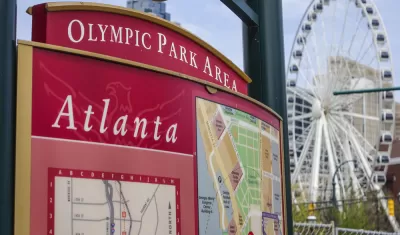
"[T]he Atlanta City Council voted to ease restrictions on downtown signage, clearing the way for billboard companies and downtown businesses to put up more of the digital displays," reports Justin Wilfon.
The likely arrival of new billboards is a controversial proposition, notes Wilfon. Central Atlanta Progress is the group behind the new approach to billboards, and the idea obviously has effective political support. According to a separate article by Rachel Dovey, Central Atlanta Progress is a private nonprofit with ties to the Atlanta Downtown Improvement District.
"The digital signs are for advertising, but revenue is slated to go toward funding public art and entertainment, WABE reports. The Atlanta Downtown Improvement District will manage them," adds Dovey.
According to an in-depth article by Stephannie Stokes, the City Council has approved a plan to "create a new Arts and Entertainment District that would allow dynamic, LED signs downtown — similar to those in New York City’s Times Square or Denver’s Theatre District." The plan's backers hope the new district will contribute a sense of vibrancy perceived as lacking from Downtown Atlanta.
Read the full story: Atlanta Group Pitches Digital Signs To Liven Up Downtown
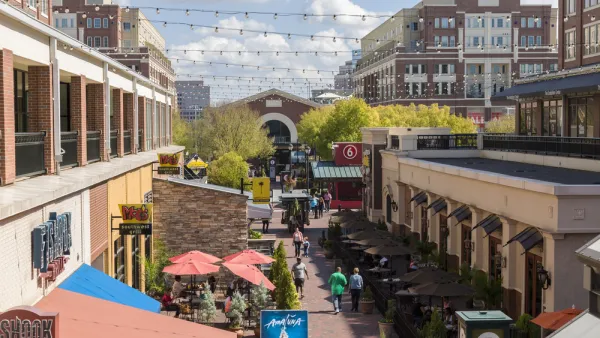
Debating Public Incentives for Private Developments
A debate common in growing cities around the country is taking place in Atlanta in answer to the question of how much support private developers need from the public.
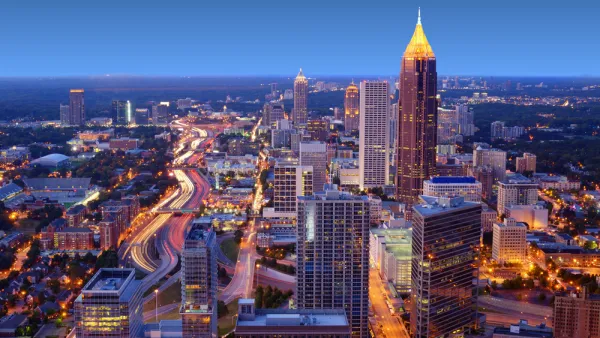
Mark Your Calendars: Draft of Downtown Atlanta Master Plan Coming Soon
A draft of the Downtown Atlanta Master Plan will be made public on September 13, 2017. The plan focuses on revitalizing the city's urban core.

12 Strategies for Revitalizing Downtowns
Even cities without an official program for revitalizing their downtowns can take steps to transform their urban cores into a collection of vibrant places. The urbanSCALE website has collected a list of such strategies.

Planetizen Federal Action Tracker
A weekly monitor of how Trump’s orders and actions are impacting planners and planning in America.

California plans to bury El Niño’s downpour
If the state plays its cards right, it may be able to store a billion acre-feet of El Niño’s water in aquifers.

Desperate measures: Advocates weigh draining Lake Powell to fill Colorado River
Draining the reservoir could reduce evaporation losses by a couple hundred thousand acre-feet.

Los Angeles just elected an urban planner as its mayor
Transportation analysts are optimistic that Raman will be more aggressive in addressing transit issues than Bass.

Mamdani’s pied-à-terre tax survives legal challenge
A panel of judges found that the plaintiffs failed to demonstrate injury as a result of New York City's implementation of the tax.

Eastern Nebraska is running out of electricity
Data centers and electrification are straining eastern Nebraska’s grid, throttling economic development.

FREE Course: Walkable City 1: Why Walkability?
After describing his path towards focusing on walkability as the essence of good planning, Jeff Speck marches through his five principal reasons for making more walkable places.
Reinventing Malls: Planning Alchemy—Turning Gray Fields Into Gold
The course focuses on the opportunities and imperatives that shape reinvention of mall sites.

City of Rosemead
Rutgers University, Edward J. Bloustein School of Planning and Public Policy
One Hundred Miles
University of Michigan School for Environment and Sustainability (SEAS)
Hunter College, City University of New York (CUNY)
The Architects Foundation
City of Cambridge
Montrose County
The Pocatello Development Authority