In its bid to host the World Cup in either 2018 or 2022, the United States has narrowed its list of possible host cities down to 18. Notably missing are San Francisco and Chicago.


"The USA Bid Committee wrapped up its eight-month selection process Tuesday, choosing 18 cities to be included in the country's official bid that must be submitted to FIFA by May 14. If the U.S. beats out the likes of England and Russia to host the 2018 World Cup, there are millions of dollars and jobs at stake for these host cities."
"The bid panel selected: Atlanta; Baltimore; Boston; Dallas; Denver; Houston; Indianapolis; Kansas City; Los Angeles; Miami; Nashville; New York; Philadelphia; Phoenix; San Diego; Seattle; Tampa; and Washington, D.C."
The economics sports consulting firm AECOM estimates that the World Cup could generate roughly $5 billion for the U.S. economy if it is selected as the host country.
Read the full story: San Francisco, Chicago left out of 2018 World Cup bid

Brazil to Receive Billions for Mobility Ahead of World Cup
The cities hosting the 2014 World Cup in Brazil have been awarded an infusion of $6 billion from the Inter-American Development Bank to fund urban mobility and other efforts ahead of the event.
Why Hosting a World Cup Doesn't Matter for Cities, and How it Can
Two major international decisions are being made today: which countries will host the 2018 and 2022 World Cups. The selected hosts will undoubtedly celebrate their victories, and look forward to the soft and hard benefits of hosting this most watched of sporting events. The host countries should also take care to prepare for negative impacts – short- and long-term effects that play out in physical, social and economic ways. Who gets selected is surely important in some ways, but when considering these mega-events in terms of their potential impact on the places in which they're held, who hosts the World Cup doesn't really matter.
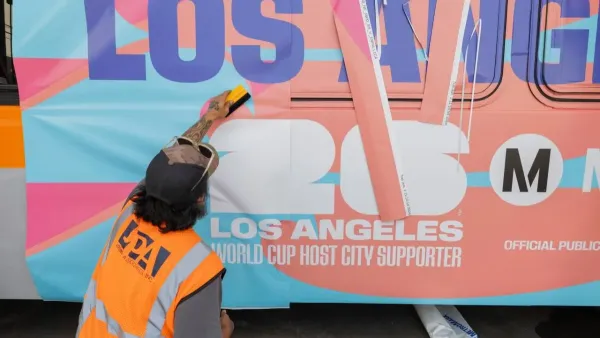
LA doesn’t need new transit for LA28: it needs to connect the transit it already has
The 2026 FIFA World Cup in Los Angeles showed that if the county’s transit providers work together, they can move thousands of people with ease. With two years remaining before the Games, the region should treat that success as inspiration, not a finish line.

Planetizen Federal Action Tracker
A weekly monitor of how Trump’s orders and actions are impacting planners and planning in America.

California plans to bury El Niño’s downpour
If the state plays its cards right, it may be able to store a billion acre-feet of El Niño’s water in aquifers.

Chicago breaks ground on $3 billion megadevelopment
The new neighborhood, titled Foundry Park, will one day host 3,700 residences.

Want to study the Missouri River? Soon, you may need unanimous approval from 10 states
Legislation would require 10 governors’ permission to study or build projects moving water outside the basin.

Desperate measures: Advocates weigh draining Lake Powell to fill Colorado River
Draining the reservoir could reduce evaporation losses by a couple hundred thousand acre-feet.

This road in NYC is infamously dangerous — and Mamdani can't fix it
New York City's Ocean Parkway is known for reckless driving, but the power to implement safety measures lies with the state rather than the city.

FREE Course: Walkable City 1: Why Walkability?
After describing his path towards focusing on walkability as the essence of good planning, Jeff Speck marches through his five principal reasons for making more walkable places.
Reinventing Malls: Planning Alchemy—Turning Gray Fields Into Gold
The course focuses on the opportunities and imperatives that shape reinvention of mall sites.

City of Rosemead
Rutgers University, Edward J. Bloustein School of Planning and Public Policy
One Hundred Miles
Hunter College, City University of New York (CUNY)
The Architects Foundation
University of Cincinnati Online
City of Cambridge
Montrose County
The Pocatello Development Authority