Recovery in New Orleans doesn't just mean rebuilding the city as it was before Hurricane Katrina. Some see the process as creating an entirely new city.


As the population climbs back to nearly 75% of pre-Katrina levels, the city seems to be on its way to becoming a healthy city again. But things weren't necessarily ideal before Katrina, so some are questioning whether it's even the right decision to try to get back to where the city once was.
"So instead of returning to a decaying economic structure, New Orleans is talking about revitalization, a buzzword behind the new energy in the city, carried by an intensity and idealism that would have bordered on indecent in the old, charmingly carefree New Orleans.
It is there among the legion of young nonprofit workers crowding the bars of the Bywater at night, drawn to what one described as her generation's civil rights struggle. They envision the city as a national example for innovative schools, smart urban planning and a housing stock built to the highest environmental standards."
Read the full story: In New Orleans, Recovery Is Not Enough
Improvement, But Room for More in New Orleans
Five years after Hurricane Katrina hit New Orleans, the Brookings Institution offers an analysis of the city's recovery. This op-ed looks at the report, which finds the city improving, but with many areas needing increased focus.
Community Rebuilding in New Orleans
Rebuilding is underway in New Orleans. But not with huge conglomerates running the show. Most of the work is being done by non-profits, startups and other community-based organizations.
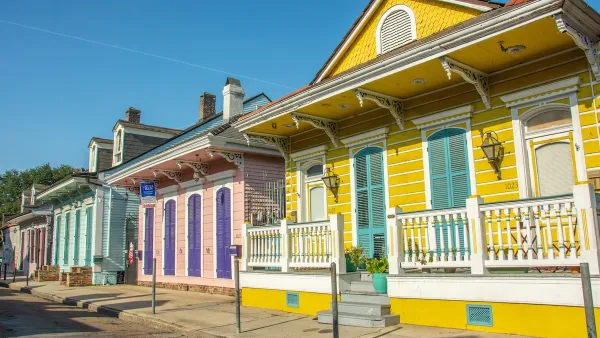
20 Years After Katrina, New Orleans is More Unaffordable Than Ever
The city’s post-hurricane redevelopment has failed to include its most vulnerable residents.

Planetizen Federal Action Tracker
A weekly monitor of how Trump’s orders and actions are impacting planners and planning in America.

California plans to bury El Niño’s downpour
If the state plays its cards right, it may be able to store a billion acre-feet of El Niño’s water in aquifers.

Desperate measures: Advocates weigh draining Lake Powell to fill Colorado River
Draining the reservoir could reduce evaporation losses by a couple hundred thousand acre-feet.

US buildings threatened, destroyed by fires set to triple by 2060
Researchers found a high fire risk for socioeconomically vulnerable neighborhoods in the American West.

LA residents may be allowed to paint their own crosswalks
Councilwoman Katy Yaroslavsky put out a motion instructing the Los Angeles Department of Public Transportation to study the feasibility of allowing volunteers to paint crosswalks.

Dallas moves to overhaul its zoning code
The city's zoning reform will allow more multi-family and mixed-use developments.

FREE Course: Walkable City 1: Why Walkability?
After describing his path towards focusing on walkability as the essence of good planning, Jeff Speck marches through his five principal reasons for making more walkable places.
Reinventing Malls: Planning Alchemy—Turning Gray Fields Into Gold
The course focuses on the opportunities and imperatives that shape reinvention of mall sites.

City of Rosemead
Rutgers University, Edward J. Bloustein School of Planning and Public Policy
One Hundred Miles
Hunter College, City University of New York (CUNY)
The Architects Foundation
University of Cincinnati Online
City of Cambridge
Montrose County
The Pocatello Development Authority