The construction of a new airport and industrial district on Florida's panhandle characterizes the impact of the St. Joe Company, the state's biggest landowner and one in the midst of drastically changing the area's landscape.


This piece from Miller-MCCune looks at the history of the St. Joe Company's developments in Florida and how they could have a devastating effect on the region's environment.
"But the new Bay County International has an important backer: The St. Joe Company, one of the largest private landowners in Florida, a former paper company turned real estate visionary and likely the largest political force in the state. The airport will be built on 4,000 acres donated by St. Joe, and it will abut almost 78,000 acres of St. Joe lands that are today a largely inaccessible mix of pine forests, shallow swamps and blackwater creeks. If all works as planned, these lands will be transformed into industrial parks, neighborhoods, recreation areas and businesses. As Randy Curtis, the executive director of the Panama City/Bay County Airport, told a reporter, the airport will create fundamental change: 'The planning process isn't the same, but in a lot of ways the situation is comparable to Ft. Myers 25 years ago. The relocation of the airport is going to be the trigger to remake the entire Bay County area.'"
Read the full story: The Panhandle Paradox
Wetlands and Airports: A Surprisingly Effective Combination
When the airport was built in Santa Barbara, California, engineers dammed the surrounding wetlands to prevent flooding and to keep birds from gathering. A new restoration refutes those conclusions, and paves (or unpaves) the way for other airports.
Satanic place names
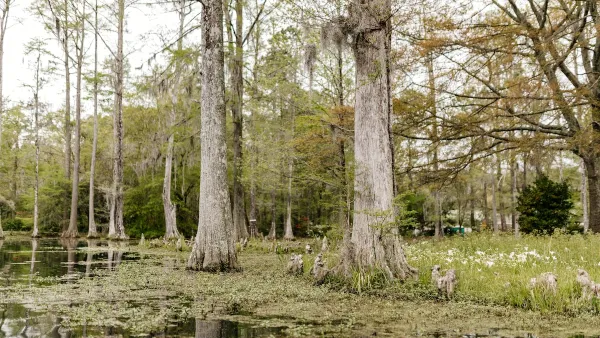
From streams and lakes to valleys and canyons, I mapped more than 1,000 places named after the Devil.
94% of wetlands could lose federal protections under proposed EPA rule
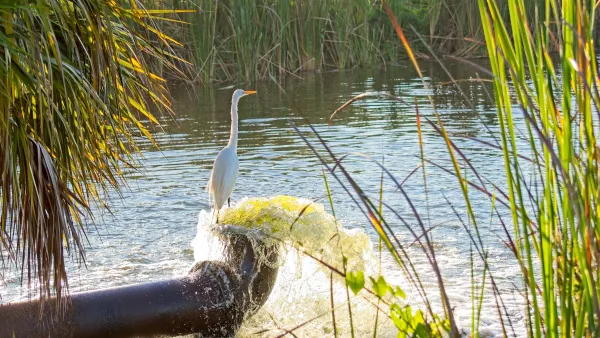
The ruling would only allot federal protections to waterways that flow nearly everyday, which few wetlands do.

Planetizen Federal Action Tracker
A weekly monitor of how Trump’s orders and actions are impacting planners and planning in America.

California plans to bury El Niño’s downpour
If the state plays its cards right, it may be able to store a billion acre-feet of El Niño’s water in aquifers.

Desperate measures: Advocates weigh draining Lake Powell to fill Colorado River
Draining the reservoir could reduce evaporation losses by a couple hundred thousand acre-feet.

Mamdani’s pied-à-terre tax survives legal challenge
A panel of judges found that the plaintiffs failed to demonstrate injury as a result of New York City's implementation of the tax.

Eastern Nebraska is running out of electricity
Data centers and electrification are straining eastern Nebraska’s grid, throttling economic development.

Seattle passes record-breaking transit services expansion
Proposition 1 will double the city’s transit tax to add 95,000 more bus trips and preserve 180,000 bus trips annually.

FREE Course: Walkable City 1: Why Walkability?
After describing his path towards focusing on walkability as the essence of good planning, Jeff Speck marches through his five principal reasons for making more walkable places.
Reinventing Malls: Planning Alchemy—Turning Gray Fields Into Gold
The course focuses on the opportunities and imperatives that shape reinvention of mall sites.

City of Rosemead
Rutgers University, Edward J. Bloustein School of Planning and Public Policy
One Hundred Miles
Hunter College, City University of New York (CUNY)
The Architects Foundation
University of Cincinnati Online
City of Cambridge
Montrose County
The Pocatello Development Authority