Minorities are on the rise in the U.S., but the rates of growth for Hispanics and Asians are slowing down, according to recent Census figures.


"[B]irths outnumber deaths among Hispanic people by 10 to 1, and the nation's racial and ethnic minorities are poised to become a majority among children under 5. They inched up from 46.7 percent of those children on July 1, 2007, to 47.3 percent last July 1.
The latest census estimates found that the minority population - other than non-Hispanic whites - grew by 2.3 percent from July 1, 2007, to July 1, 2008, compared with 2.4 percent the year before.
Ethnic and racial minorities (mostly blacks, Hispanic and Asian people) now account for 34 percent of the nation's population.
The Hispanic population grew by 3.2 percent and Asians by 2.7 percent, a slight decrease from the year before. But those figures were down sharply from the beginning of the decade, when the Hispanic population grew by 4 percent and Asians by 3.7 percent, according to an analysis by the Population Reference Bureau, a private research group."
Read the full story: Asian and Hispanic Minorities Growing, but More Slowly
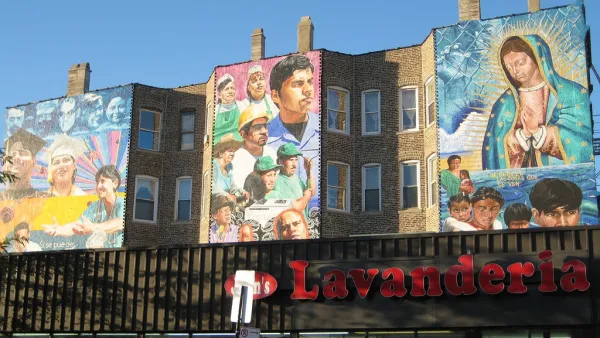
Mapping the Growth of the U.S. Hispanic Population
Almost every county in the country has more Hispanics than in 2010, according to recent Census data now searchable by interactive map.

What President Trump's Border Wall Can't Stop
William H. Frey, a demographer with Brookings, argues that racial diversity is a good thing for the country by many measures. Trump's wall would make it harder to benefit from demographic changes, but changes is still coming.

Census Projections: U.S. Will Become 'Majority Minority' in 2045
William H. Frey reports that new Census projections have the United States becoming "minority white" in 2045.

Planetizen Federal Action Tracker
A weekly monitor of how Trump’s orders and actions are impacting planners and planning in America.

Eastern Nebraska is running out of electricity
Data centers and electrification are straining eastern Nebraska’s grid, throttling economic development.

Study reveals best places in the U.S. for cycling, walking
New research from Streetlight Data examines bicycle and pedestrian miles per capita in the 100 largest U.S. cities by population.

Developers reveal $10 billion stadium plan as ‘Hail Mary’ to keep Bears in Chicago
The plan would also boast a public park, high- and mid-rise buildings and a youth sports complex.

As Texas embraces carbon storage, a Black community questions the risks
Texas now issues permits for companies to store carbon dioxide underground. East Texas residents fear safety risks, and skeptics doubt the climate benefits.

New BLM proposal would slash public comment periods, environmental protections
The proposed rewrite would also strip legal leverage from Tribal nations and state governments.

FREE Course: Walkable City 1: Why Walkability?
After describing his path towards focusing on walkability as the essence of good planning, Jeff Speck marches through his five principal reasons for making more walkable places.
Reinventing Malls: Planning Alchemy—Turning Gray Fields Into Gold
The course focuses on the opportunities and imperatives that shape reinvention of mall sites.

City of Rosemead
Rutgers University, Edward J. Bloustein School of Planning and Public Policy
One Hundred Miles
University of Michigan School for Environment and Sustainability (SEAS)
Hunter College, City University of New York (CUNY)
The Architects Foundation
City of Cambridge
The Pocatello Development Authority
The Urban Renewal Agency of the City of Pocatello