In the sixth of a ten-part series, National Public Radio investigates the sustainability of smart grid technology in the places where its likely to be applied.


"The push is on to make the nation's aging electricity grid smarter, so it can handle growing demand for electricity. Many assume that a smart grid will also be a green grid - delivering clean electricity and helping to address climate change. But that's not necessarily so."
"Smart grid technology means several kinds of innovations. One is that both customers and utilities will be able to monitor electric use, minute by minute. Steve Nadel, who runs a nonprofit called the American Council for an Energy-Efficient Economy, says information alone doesn't make the smart grid green."
"In California, San Diego Gas and Electric has been pushing to build a major new power line into the neighboring Imperial Valley. The utility has been selling the idea in part on its environmental benefits.
But California Public Utilities Commissioner Dian Grueneich is skeptical.
"Anybody who's proposing a transmission line in the United States these days is going to claim it's going to be used for renewable - it's going to be a 'green' line because that's mom and apple pie," Grueneich says."
""This isn't rocket science. We don't need to develop whole new technologies," she says. "We aren't making bets on will we be able to develop a whole new way of doing things. It's just really being serious. If we're going to spend this money and call something green, let's make sure it happens."
Thanks to Franny Ritchie
Read the full story: The Grid May Be Smart, But Will It Also Be Green?
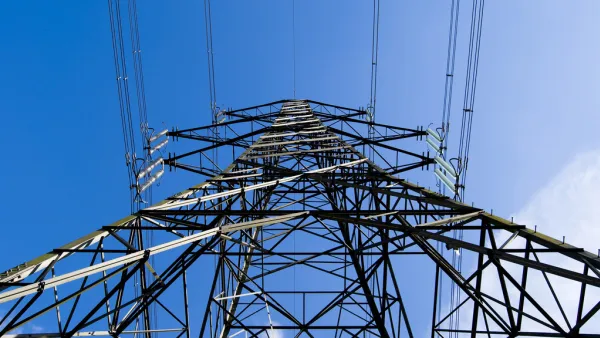
A New Commitment to an Efficient, Smart Grid in Arizona
Arizona's largest electric utility is proposing a set of next-gen energy conservation tools for its customers, as well as an accompanying educational component.

Learning loss and urban schools, part 2
Did test scores in progressive cities drop more post-COVID than test scores in moderate ones?
CA officials have the power to fix the state’s riskiest dams. They’ve never used it
California’s 40 most hazardous dams would endanger up to 1.5 million people if they failed.

Planetizen Federal Action Tracker
A weekly monitor of how Trump’s orders and actions are impacting planners and planning in America.

California plans to bury El Niño’s downpour
If the state plays its cards right, it may be able to store a billion acre-feet of El Niño’s water in aquifers.

Desperate measures: Advocates weigh draining Lake Powell to fill Colorado River
Draining the reservoir could reduce evaporation losses by a couple hundred thousand acre-feet.

Los Angeles just elected an urban planner as its mayor
Transportation analysts are optimistic that Raman will be more aggressive in addressing transit issues than Bass.

Mamdani’s pied-à-terre tax survives legal challenge
A panel of judges found that the plaintiffs failed to demonstrate injury as a result of New York City's implementation of the tax.

Eastern Nebraska is running out of electricity
Data centers and electrification are straining eastern Nebraska’s grid, throttling economic development.

FREE Course: Walkable City 1: Why Walkability?
After describing his path towards focusing on walkability as the essence of good planning, Jeff Speck marches through his five principal reasons for making more walkable places.
Reinventing Malls: Planning Alchemy—Turning Gray Fields Into Gold
The course focuses on the opportunities and imperatives that shape reinvention of mall sites.

City of Rosemead
Rutgers University, Edward J. Bloustein School of Planning and Public Policy
One Hundred Miles
University of Michigan School for Environment and Sustainability (SEAS)
Hunter College, City University of New York (CUNY)
The Architects Foundation
City of Cambridge
Montrose County
The Pocatello Development Authority