Advocacy group KaBOOM have launched a campaign to map play places across the U.S. called 100,000 Playspaces in 100 Days. The goal is to create a useful tool for planners for evaluating networks of parks and recreation.


"...Dancing With the Stars winner Julianne Hough will donate a dollar to children's charities for every play place in the United States marked by users on a map, up to $100,000. The end result will be a comprehensive map of places designated for play in cities and towns across America, giving planners and the growing ranks of their DIY counterparts a valuable tool for improving local play networks.
Of course, the mapping campaign only takes into account the sanctioned play areas in a city, with categories for playgrounds, ice rinks, skateparks, swimming pools, and play fields for baseball, football, soccer, and basketball. As every city-dweller knows, these places are important, but kids will play anywhere and everywhere. If a skatepark or playground is not provided, benches and planters will often suffice. The same can be said of streets and open lots standing in for absent sports fields. While the KaBOOM map will undoubtedly be a useful resource, the line between formal and informal play places is often more subtle than this mapping project can account for."
Read the full story: Playful Infrastructure

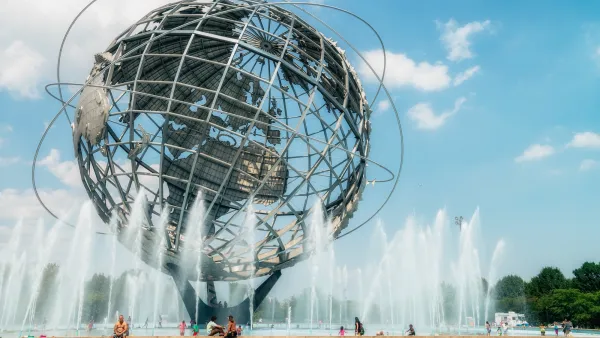
Historic Queens park is getting a $120M upgrade
The borough's largest park will undergo significant upgrades for accessibility, flood mitigation and historic preservation.
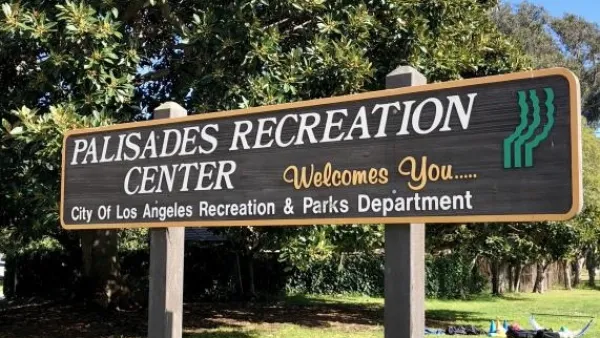
Private Donations Propel Early Restoration of Palisades Playground
Los Angeles has secured over $1.3 million in private funding to restore the Pacific Palisades playground months ahead of schedule, creating a modern, accessible space that supports community healing after recent wildfires.
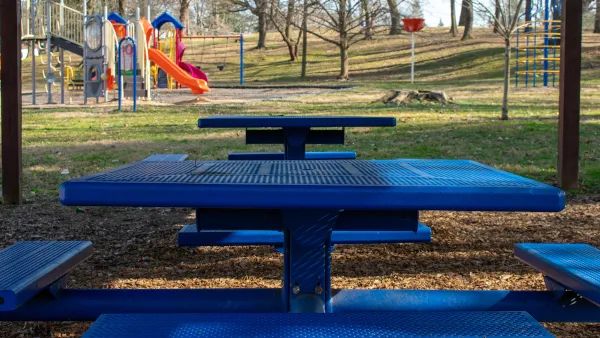
A Data-Driven Approach to ‘Playspace Inequity’
Mapping playgrounds and their conditions can reveal how childhood play opportunities are inequitably distributed within cities.

Planetizen Federal Action Tracker
A weekly monitor of how Trump’s orders and actions are impacting planners and planning in America.

California plans to bury El Niño’s downpour
If the state plays its cards right, it may be able to store a billion acre-feet of El Niño’s water in aquifers.

Chicago breaks ground on $3 billion megadevelopment
The new neighborhood, titled Foundry Park, will one day host 3,700 residences.

Want to study the Missouri River? Soon, you may need unanimous approval from 10 states
Legislation would require 10 governors’ permission to study or build projects moving water outside the basin.

Desperate measures: Advocates weigh draining Lake Powell to fill Colorado River
Draining the reservoir could reduce evaporation losses by a couple hundred thousand acre-feet.

This road in NYC is infamously dangerous — and Mamdani can't fix it
New York City's Ocean Parkway is known for reckless driving, but the power to implement safety measures lies with the state rather than the city.

FREE Course: Walkable City 1: Why Walkability?
After describing his path towards focusing on walkability as the essence of good planning, Jeff Speck marches through his five principal reasons for making more walkable places.
Reinventing Malls: Planning Alchemy—Turning Gray Fields Into Gold
The course focuses on the opportunities and imperatives that shape reinvention of mall sites.

City of Rosemead
Rutgers University, Edward J. Bloustein School of Planning and Public Policy
One Hundred Miles
Hunter College, City University of New York (CUNY)
The Architects Foundation
University of Cincinnati Online
City of Cambridge
Montrose County
The Pocatello Development Authority