Environmental artists Christo and Jeanne-Claude, famous for the orange 'Gates' project in Central Park, are planning to run a 5.9 mile silver cloth over a whitewater river in Colorado. Environmentalists aren't happy about it.


"The environmental art duo who brought us Running Fence in California and The Gates in New York City now have their eyes on Bighorn Sheep Canyon, a stretch of the Arkansas River known for its wildlife, fishing, and white-water rafting. You can view their concept drawings at www.overtheriver.org. The project will cover the Arkansas River with 5.9 miles' worth of "fibrillated polypropylene fabric coated with vaporized aluminum on both sides." These translucent canopies will hover eight to 25 feet above the water and reach almost bank to bank.
Some Coloradans who live near the canyon are up in arms about the project and have formed a group called ROAR (Rags Over the Arkansas River). They charge that the influx of hundreds of thousands of tourists will create a traffic nightmare on the two-lane canyon road; that the drilling required to fasten the panels will permanently deface the riverbanks; that bighorn sheep, elk, deer, and other wildlife will be kept from their drinking water; and that eagles and sports fishermen won't be able to fish the river. And, although the panels will only be in place for two weeks, Christo admits that installation and removal will disrupt the area for two to three years."
FULL STORY: Should a River Run Under It?

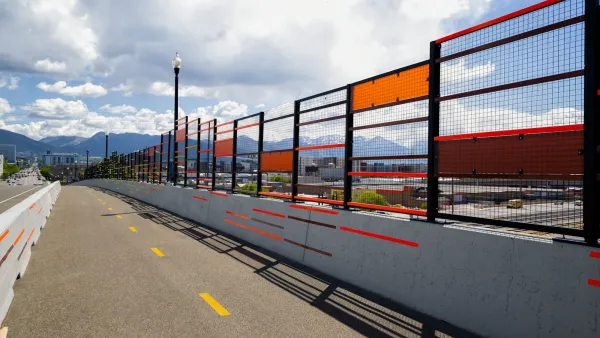
Salt Lake City opens protected bike path on viaduct trail
The 400 South Viaduct Trail features the state's longest continuous piece of public art.
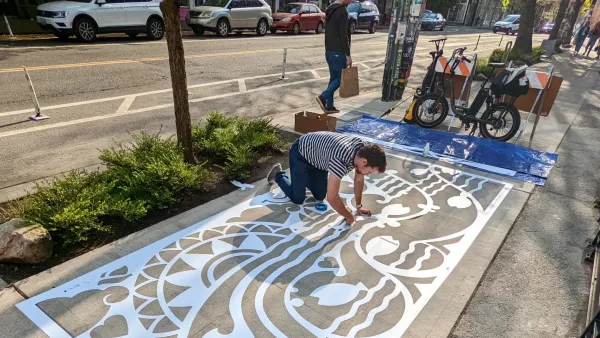
This Seattle sidewalk art only appears when it rains
Prompted to find a silver lining to the gloom of rainy Pacific Northwest days, an artist hit upon a novel solution: water-activated sidewalk paint.
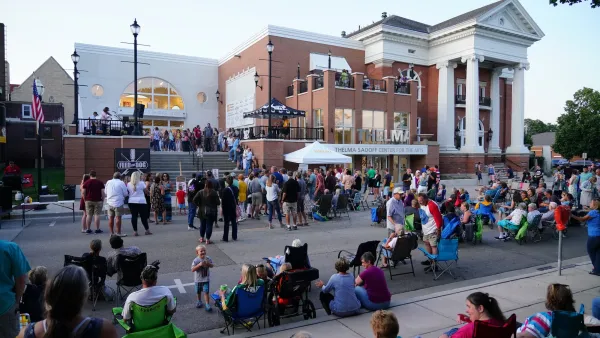
How Placemaking Lost its Way — And How it Can Get Back on Track
The term has often become diluted, getting attached to projects that don’t live up to its lofty aspirations.

Planetizen Federal Action Tracker
A weekly monitor of how Trump’s orders and actions are impacting planners and planning in America.

The state-sanctioned urbicide of Austin
People don’t kill cities. Freeways do.

US to reduce Colorado River water deliveries to Mexico
A new Colorado Treaty amendment reduces Mexico’s Colorado River water allocation by 250,000 acre feet.

5 New England states march closer to 800 megawatt wind energy project
Securing federal approval for the project may be complicated under the Trump administration, which has historically been hostile towards domestic wind power.

Baltimore to break ground on $50 million Transit Priority Project
The project will bring faster bus trips, safer streets and better bike connections to Baltimore.

Airbnb launches $250 million 'last-dollar financing' housing accelerator, makes first investment in Austin
The company will put $6.4 million towards affordable housing development in Texas’ capital.

FREE Course: Walkable City 1: Why Walkability?
After describing his path towards focusing on walkability as the essence of good planning, Jeff Speck marches through his five principal reasons for making more walkable places.
Reinventing Malls: Planning Alchemy—Turning Gray Fields Into Gold
The course focuses on the opportunities and imperatives that shape reinvention of mall sites.

Eagle County Government
Harvard University Graduate School of Design
Nashville Planning Department
The Architects Foundation
University of Cincinnati Online
The Pocatello Development Authority
The Urban Renewal Agency of the City of Pocatello
Journal of the American Planning Association