This piece from Next American City looks at the human toll major building projects are taking on construction workers in China, Dubai and other rapidly developing places.


"We are in the midst of a breathtaking round of mega-project construction, and it is happening mainly in Asia and the Middle East. China and the United Arab Emirates are leading the movement, and neither is known for being labor friendly, to put it mildly."
"Working conditions for migrants in Dubai are appalling. The government reported 39 people dead from workplace accidents in 2005 alone, which is likely to be a conservative estimate. This maltreatment caused a riot by 2,500 fed up laborers working on the Burj Dubai, which temporarily halted construction in 2006. That at least forced the government to acknowledge the problem, which so far has only amounted to lip service."
"As with Dubai, the construction booms in magnet cities like Shanghai, Beijing and Guangzhou flourish on migrant labor, but from China's own rural interior instead of foreign countries. There are 150 million rural laborers living in cities. The cities count on them to toil cheaply and without complaint."
Read the full story: The Dark Side of the Construction Boom

Dubai's Migrant Construction Workers Bear Brunt of Downturn
The economic downturn is hurting Dubai, as glitzy skyscraper projects come to a halt. But the biggest pain is being felt among the hundreds of thousands of migrant construction workers who came to the city seeking their fortunes.
Wisconsin's declining population reduces housing needs by almost 50%
The state's working age population declined by over 25,000 people between 2020 and 2024.
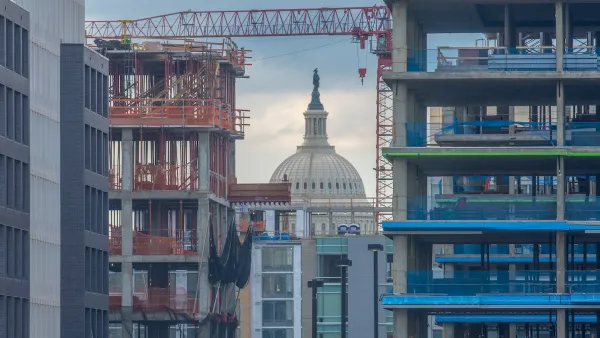
92% of DC Construction Groups Struggle to Hire Workers Amid ICE Raids
Contractors are being forced to delay project timelines as more workers stay home to avoid ICE dragnets.

Planetizen Federal Action Tracker
A weekly monitor of how Trump’s orders and actions are impacting planners and planning in America.

The state-sanctioned urbicide of Austin
People don’t kill cities. Freeways do.

US to reduce Colorado River water deliveries to Mexico
A new Colorado Treaty amendment reduces Mexico’s Colorado River water allocation by 250,000 acre feet.

Nation's most wind-powered state turns to coal as data centers increase energy demand
For the first time in decades, Iowa has increased its generation of coal power.

NYC cools commuters with city's first rain garden above a bus stop
New York City officials say the plants in the rain garden can absorb 16 gallons of rainwater during heavy storms.

Brightline West’s future may rely on $6 billion federal loan
The company has until Nov. 2 to make a $400 million equity investment into its proposed high-speed rail line.

FREE Course: Walkable City 1: Why Walkability?
After describing his path towards focusing on walkability as the essence of good planning, Jeff Speck marches through his five principal reasons for making more walkable places.
Reinventing Malls: Planning Alchemy—Turning Gray Fields Into Gold
The course focuses on the opportunities and imperatives that shape reinvention of mall sites.

Eagle County Government
Harvard University Graduate School of Design
Nashville Planning Department
The Architects Foundation
University of Cincinnati Online
The Pocatello Development Authority
The Urban Renewal Agency of the City of Pocatello
Journal of the American Planning Association