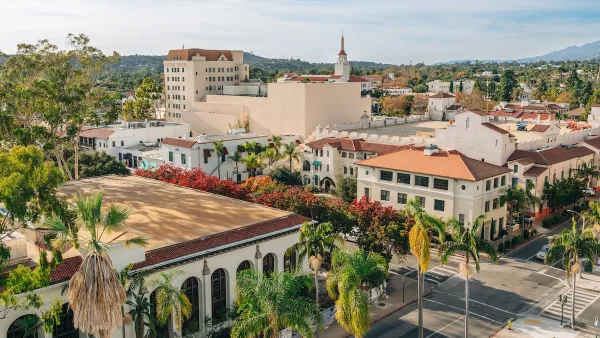
The Economist wonders if Santa Barbara's relative financial health is owed to its aging population and resistance to development.


"Nowhere in California is immune to recession, but the oldest areas are proving most resistant. Of the ten counties with the lowest unemployment rates, nine, including Santa Barbara, contain an above-average proportion of people aged 65 or older. Youthful Los Angeles has shed almost a quarter-of-a-million jobs in the past year. Slightly older San Diego has lost a few thousand, while considerably older San Francisco has lost none.
Santa Barbara has watched all this from the sidelines. In this slow-growth stronghold, anything other than a glacial pace of development is anathema. Mr Cushman says that only one block of flats for rent has been built in the region in the past 30 years. And some want to curtail growth further. Health care is the only private-sector industry in California that accounted for job growth in 2008. Here, too, places benefit from having a fairly old population.
In the past ten years, obedient to the findings of urban sociologists, American cities have tripped over themselves vying for young, creative people. They have revitalised downtowns and sponsored gay-pride parades. They might have been better off building retirement homes."
Read the full story: Gilded age

Santa Barbara Could Build Housing on County Land
County supervisors moved forward a proposal to build workforce housing on two county-owned parcels.

Santa Barbara Renews Parklet Program
The city updated its pandemic-era on-street dining program with new regulations that limit the locations and design of parklets.

Santa Barbara Expands ADU Program to Boost Housing
The city hopes that permitting larger ADUs and making adaptive reuse easier will help it meet its state-mandated goal of building over 8,000 new housing units by 2031.

Planetizen Federal Action Tracker
A weekly monitor of how Trump’s orders and actions are impacting planners and planning in America.

‘Going backwards:’ Baltimore mayor, students rally against state's transit funding plan
Maryland's proposed six-year plan provides no funding for Baltimore’s BMORE bus program and reduces its road maintenance funding.

Mamdani sent nearly 6,000 pied-à-terre tax warnings to homes that didn’t qualify
A judge has ordered the administration to cancel thousands of pied-à-terre tax notices after it sent 35% of them erroneously.

Mamdani sent nearly 6,000 pied-à-terre tax warnings to homes that didn’t qualify
A judge has ordered the administration to cancel thousands of pied-à-terre tax notices after it sent 35% of them erroneously.

Detroit to transform waterfront with $2.2 billion investment
Developers will convert about 18 acres of unused parking lot space into civic spaces.

‘Going backwards:’ Baltimore mayor, students rally against state's transit funding plan
Maryland's proposed six-year plan provides no funding for Baltimore’s BMORE bus program and reduces its road maintenance funding.

FREE Course: Walkable City 1: Why Walkability?
After describing his path towards focusing on walkability as the essence of good planning, Jeff Speck marches through his five principal reasons for making more walkable places.
Reinventing Malls: Planning Alchemy—Turning Gray Fields Into Gold
The course focuses on the opportunities and imperatives that shape reinvention of mall sites.

City of Thousand Oaks
City of Wisconsin Rapids
Harvard University Graduate School of Design
The Architects Foundation
University of Cincinnati Online
Northern Illinois Transit Authority (NITA)
The Pocatello Development Authority
The Urban Renewal Agency of the City of Pocatello