The federal stimulus package has made infrastructure into a hot topic among states. But, as Mary Newsom writes, states are not addressing the land use patterns that drive up the costs and bring down the efficiency of infrastructure.


"These days, recession-pummeled Americans are following the federal stimulus package almost as avidly as, in happier times, they obsessed over Anna Nicole Smith or Laci Peterson. They're arguing whether stimulus money should go to the arts, or to repair and expand infrastructure, such as fixing bridges, boosting transit or finishing urban loop roads."
"It's about time people noticed those public works projects."
"But is the welcome public attention also spotlighting one of the reasons our infrastructure spending is so high–the vast sums required by suburban sprawl? In fast-growing North Carolina, at least, it isn't."
Read the full story: States Wear Blinders On The True Costs of Sprawl
Obama Plan: Stimulating The Economy Or Sprawl?
Obama has compared the size of the stimulus package he wants to the 1956 National Highway Act. If the states have their way, it may be just that -- a new highway bill with little left for transit.
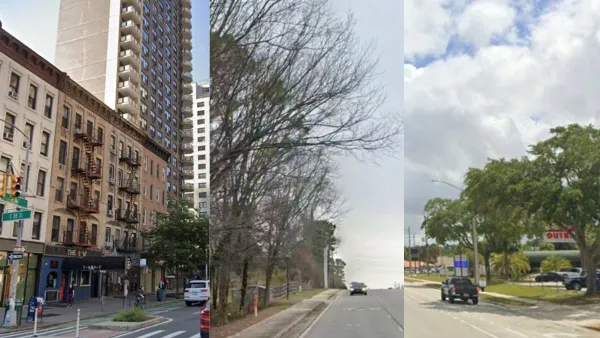
A Transect of sprawl
A development pattern this lifestyle-defining deserves its whole own classification system.

What the fall of earth's largest pre-industrial city can teach us about urban sprawl
Angkor was a low-density metropolis. It lasted six centuries, until it could no longer maintain its infrastructure in a changing climate. Today, it offers planners a sobering warning about the risks of dispersed urban living.

Planetizen Federal Action Tracker
A weekly monitor of how Trump’s orders and actions are impacting planners and planning in America.

California plans to bury El Niño’s downpour
If the state plays its cards right, it may be able to store a billion acre-feet of El Niño’s water in aquifers.

Desperate measures: Advocates weigh draining Lake Powell to fill Colorado River
Draining the reservoir could reduce evaporation losses by a couple hundred thousand acre-feet.

Chicago voters approve permanent festival grounds, penalty for vacant property owners
Currently, major summer and fall festivals take over public parks for weeks at a time, drawing criticism from nearby residents

NYC votes to cut outdoor dining red tape, speed up permitting
New York City also voted to allow the Department of Transportation to begin work on urgent projects before notifying elected officials.

California appears to reject Prop. 45
The proposition would have expanded the projects that qualify for a streamlined environmental review, effectively paring down the California Environmental Quality Act.

FREE Course: Walkable City 1: Why Walkability?
After describing his path towards focusing on walkability as the essence of good planning, Jeff Speck marches through his five principal reasons for making more walkable places.
Reinventing Malls: Planning Alchemy—Turning Gray Fields Into Gold
The course focuses on the opportunities and imperatives that shape reinvention of mall sites.

City of Rosemead
Rutgers University, Edward J. Bloustein School of Planning and Public Policy
One Hundred Miles
Hunter College, City University of New York (CUNY)
The Architects Foundation
University of Cincinnati Online
City of Cambridge
Montrose County
The Pocatello Development Authority