As the economy dives and housing values plummet, revenue from property taxes is expected to fall over the next few years, making things tough for many cities.


"In the current recession, real estate values are plummeting, foreclosures are rising and huge numbers of taxpayers are disappearing from tax rolls. 'The property tax,' says Guy Griscom, past president of the International Association of Assessing Officers, 'is the primary source of revenue for localities. Right now, it's threatened.'"
"Whatever the law may be in a given jurisdiction, it's inevitable that when assessed values fall, the tax base ultimately shrinks. There is less money to spend for public purposes. 'We are still in phase one of what is likely to be a several-year cycle of property tax revenue declines for locals,' says Chris Hoene, of the National League of Cities. 'We've only just entered the woods.'"
"Whatever the law may be in a given jurisdiction, it's inevitable that when assessed values fall, the tax base ultimately shrinks. There is less money to spend for public purposes. 'We are still in phase one of what is likely to be a several-year cycle of property tax revenue declines for locals,' says Chris Hoene, of the National League of Cities. 'We've only just entered the woods.'"
"And for many homeowners, the woods will be full of unpleasant surprises this year. For example, every state sets an assessment date for establishing the value of property in the coming tax year. In many states, that date is January 1. Property owners receive a notice of the evaluation and of what their property tax will be some three or four months later. If the value of a house drops between the assessment date and receipt of the tax bill, that downward change is rarely reflected in the bill. The gut reaction of the homeowners is often vitriolic. They see themselves as being taxed on an unrealistic and unwarranted value. This is especially true right now."
"'What taxpayers might not understand,' Griscom says, 'is that they are going to pay taxes at the end of 2009 based on the value levied at the beginning of the year.'"
Read the full story: A Break in the Levy

Property Tax Revenue Downturn Hurting Cities
The economic recession is lightening up in some areas, but cities and municipalities will continue to struggle with the downturn in the economy for years, mainly because of falling property tax revenues.
California's Troubles Not the Fault of Prop 13
This article from City Journal suggests that California's much-reviled Proposition 13 limits on increases in property tax is not at fault for the state's crippling fiscal situation.
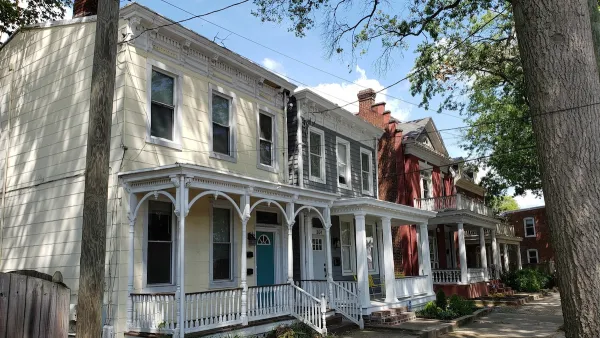
Property Taxes Cuts on the Ballot in at Least Eight States
From completely eliminating property tax to creating new exemptions, voters in eight states across the country will cast their votes on a variety of ballot measures that could have major implications for local budgets.

Planetizen Federal Action Tracker
A weekly monitor of how Trump’s orders and actions are impacting planners and planning in America.

The state-sanctioned urbicide of Austin
People don’t kill cities. Freeways do.

US to reduce Colorado River water deliveries to Mexico
A new Colorado Treaty amendment reduces Mexico’s Colorado River water allocation by 250,000 acre feet.

Brightline West’s future may rely on $6 billion federal loan
The company has until Nov. 2 to make a $400 million equity investment into its proposed high-speed rail line.

LA Metro’s ultimatum: no extra buses for LA28 if federal funding isn’t imminently secured
If Metro does not provide additional buses, LA28 organizers will have to find a new way to manage Olympic traffic. LA28’s budget does not include a line item for transit.

Colorado’s Largest Data Center Could Rise Next to Homes — Without a Public Hearing
The proposed campus would consume 11 times the power of Denver International Airport; as it has across the country, opposition mounts.

FREE Course: Walkable City 1: Why Walkability?
After describing his path towards focusing on walkability as the essence of good planning, Jeff Speck marches through his five principal reasons for making more walkable places.
Reinventing Malls: Planning Alchemy—Turning Gray Fields Into Gold
The course focuses on the opportunities and imperatives that shape reinvention of mall sites.

Eagle County Government
Harvard University Graduate School of Design
Nashville Planning Department
The Architects Foundation
University of Cincinnati Online
The Pocatello Development Authority
The Urban Renewal Agency of the City of Pocatello
Journal of the American Planning Association