Leaders in Arlington, Texas, near Dallas, are studying how to reduce pollution generated by idling cars at drive-thru windows.


"Seeking to improve air quality, an Arlington citizens' group will study ways to reduce emissions from cars idling in drive-through restaurants.
'We're just trying to put our heads together and see if there's any way we can improve the situation,' City Councilwoman Sheri Capehart said Wednesday. 'And there may not be.'
She chairs a City Council committee that asked a citizens' environmental group to study the issue.
'This is an idea,' she said. 'Let's look at it.'
Capehart said she does not favor banning drive-throughs, but wants to find a way to reduce the long lines of idling cars that contribute to pollution."
Read the full story: Drive-Thrus: Convenience With a Side of Pollution
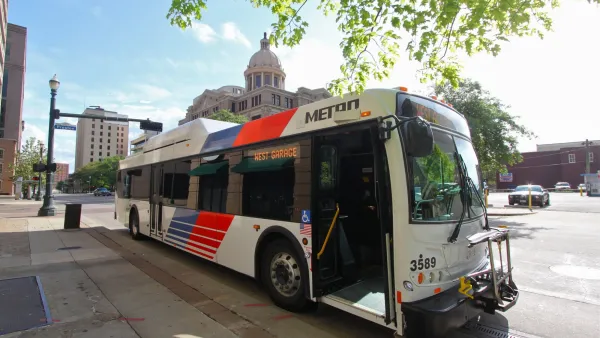
Houston Transit Agencies Offer ‘Free Fare Fridays’ for Ozone Action Month
Harris County is one of several Texas counties that failed EPA standards for clean air in recent years.

High Ozone Levels Threaten New Mexico Oil Town
The small community of Loving, New Mexico has higher ozone levels than dense cities like Los Angeles.

Report: The West Is the Worst for Air Quality
Thanks to longer fire seasons and increasingly intense blazes, Western states are experiencing the nation’s worst air quality.

Desperate measures: Advocates weigh draining Lake Powell to fill Colorado River
Draining the reservoir could reduce evaporation losses by a couple hundred thousand acre-feet.

Eastern Nebraska is running out of electricity
Data centers and electrification are straining eastern Nebraska’s grid, throttling economic development.

Malls are becoming the midtowns of the future
Mall and office park redevelopments are a generational opportunity to create new nodes of urbanity.

One Kentucky town’s secret to affordable housing
The Smoketown Community Land Trust has already built seven affordable homes for community members.

Houston gains petal-shaped cooling infrastructure to make streets more ‘delightful’
The city has installed the pavilions along 15 blocks in Houston.

After years of opposition to light rail, this L.A. city wants a $200 million station
Cerritos officials want the Southeast Gateway Line, a planned 14.5-mile light rail route through Los Angeles County, to stop in their city.

FREE Course: Walkable City 1: Why Walkability?
After describing his path towards focusing on walkability as the essence of good planning, Jeff Speck marches through his five principal reasons for making more walkable places.
Reinventing Malls: Planning Alchemy—Turning Gray Fields Into Gold
The course focuses on the opportunities and imperatives that shape reinvention of mall sites.

City of Rosemead
Rutgers University, Edward J. Bloustein School of Planning and Public Policy
One Hundred Miles
University of Michigan School for Environment and Sustainability (SEAS)
Hunter College, City University of New York (CUNY)
The Architects Foundation
City of Cambridge
Montrose County
The Pocatello Development Authority