Its history of pollution dates back to the Civil War, but 25 years after being declared a Superfund site, Woburn's Industri-plex in Massachusetts is just about cleaned up. A retail complex there has opened recently.


"To aid and protect the Industri-plex cleanup, the EPA on Jan. 13 asked the Woburn City Council to make all the site's roads public, a process the city government had already started, said Ward 5 Alderman Darlene Mercer-Bruen.
The EPA also asked Woburn to foreclose on three Industri-plex properties owned by Chestnut Hill Realty Trust. Those three parcels sit on some of the site's most contaminated land, and the sole surviving member of the trust has no interest in holding onto the property, as it has no real commercial value, LeMay said. The EPA wants a responsible property owner who will recognize the land restrictions and protect the cleanup remedy, he said.
Nearly all of the Industri-plex property has land restrictions, but the EPA has approved 10 work plans for development there. The first was the 34-acre, $10-million Anderson Regional Transportation Center, a Massachusetts Bay Transportation Authority hub that opened in 2001 and is named for Jimmy Anderson, a young child who died of cancer in 1981 and whose mother filed a lawsuit over the contamination."
Read the full story: After 25 years, Superfund site cleanup nears final phase
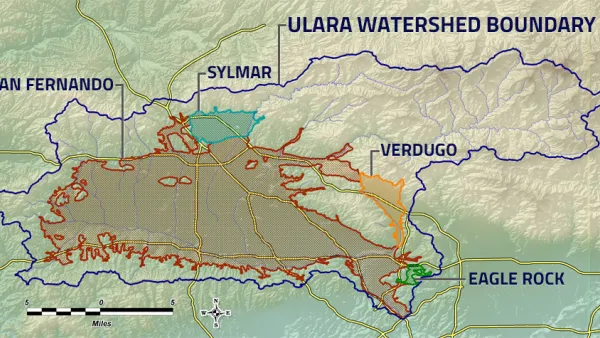
Superfund Project to Deliver Massive Water Supply Boon to Los Angeles
The semi-arid region of Los Angeles is often mistaken for a desert, but the local water supply is also constrained by the environmental sins of the 20th century. The water supply equation of Los Angeles will soon change, however.

The Surprising Oil Tax in the Inflation Reduction Act
President Biden has made reducing gas prices paramount in his administration, so it was likely a surprise to hear a Republican senator last Sunday warn TV viewers that a revived and increased oil fee in the climate bill will increase their gas costs.
Lessons in Brownfields: Phase One Report Reform Ain't Working
This second of a series on brownfield remediation and development is a funny and sarcastic primer about the process and its failures. Written by Environmental attorney Richard Opper.

Planetizen Federal Action Tracker
A weekly monitor of how Trump’s orders and actions are impacting planners and planning in America.

California plans to bury El Niño’s downpour
If the state plays its cards right, it may be able to store a billion acre-feet of El Niño’s water in aquifers.

Desperate measures: Advocates weigh draining Lake Powell to fill Colorado River
Draining the reservoir could reduce evaporation losses by a couple hundred thousand acre-feet.

Mamdani’s pied-à-terre tax survives legal challenge
A panel of judges found that the plaintiffs failed to demonstrate injury as a result of New York City's implementation of the tax.

Eastern Nebraska is running out of electricity
Data centers and electrification are straining eastern Nebraska’s grid, throttling economic development.

Seattle passes record-breaking transit services expansion
Proposition 1 will double the city’s transit tax to add 95,000 more bus trips and preserve 180,000 bus trips annually.

FREE Course: Walkable City 1: Why Walkability?
After describing his path towards focusing on walkability as the essence of good planning, Jeff Speck marches through his five principal reasons for making more walkable places.
Reinventing Malls: Planning Alchemy—Turning Gray Fields Into Gold
The course focuses on the opportunities and imperatives that shape reinvention of mall sites.

City of Rosemead
Rutgers University, Edward J. Bloustein School of Planning and Public Policy
One Hundred Miles
University of Michigan School for Environment and Sustainability (SEAS)
Hunter College, City University of New York (CUNY)
The Architects Foundation
City of Cambridge
Montrose County
The Pocatello Development Authority