Korean photographer Hosang Park's recent series exposes tiny, unknown 'parks' that are attached to housing developments around the world.


"Park's parks are photographed from above – which seems, in fact, to be the view for which they were designed. As two-dimensional compositions of curved paths, colored paving, and rhythmically spaced rocks or trees, they resemble pleasing, if sterile, designs for wrapping paper or Ikea rugs. Tellingly, they are also completely empty. Park explains that he took these photos while he was living on the 13th floor of Jugong Apartment in Chang-dong, Seoul. He and his hundreds of neighbors experienced their park as a a patch of eye candy – visual respite from the concrete and tarmac of their surroundings. Its cornucopia of amenities – climbing frames, fountains, seesaws and swing sets, pagodas, grass, ornamental rocks, meandering paths, trees and flower beds, benches, ponds, basketball courts... even public art – are crammed together as visual shorthand for endless leisure. They are landscape as signage, a placeholder for the possibilities of a park."
Read the full story: Park's Parks

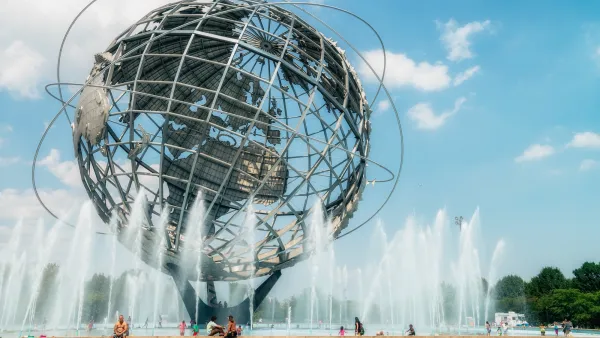
Historic Queens park is getting a $120M upgrade
The borough's largest park will undergo significant upgrades for accessibility, flood mitigation and historic preservation.
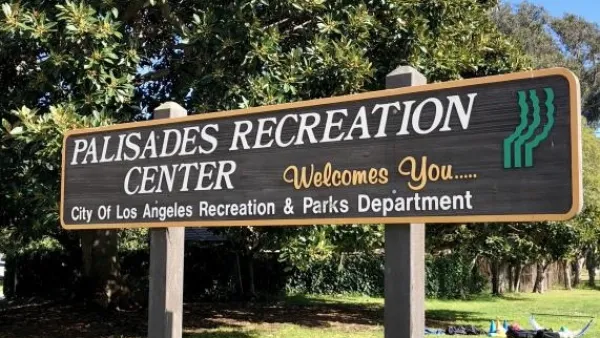
Private Donations Propel Early Restoration of Palisades Playground
Los Angeles has secured over $1.3 million in private funding to restore the Pacific Palisades playground months ahead of schedule, creating a modern, accessible space that supports community healing after recent wildfires.
Playgrounds Pop Up in New York
Neighborhoods in New York City have built temporary "pop-up" playgrounds in an effort to encourage more physical activity among children.

Planetizen Federal Action Tracker
A weekly monitor of how Trump’s orders and actions are impacting planners and planning in America.

California plans to bury El Niño’s downpour
If the state plays its cards right, it may be able to store a billion acre-feet of El Niño’s water in aquifers.

Chicago breaks ground on $3 billion megadevelopment
The new neighborhood, titled Foundry Park, will one day host 3,700 residences.

Want to study the Missouri River? Soon, you may need unanimous approval from 10 states
Legislation would require 10 governors’ permission to study or build projects moving water outside the basin.

Desperate measures: Advocates weigh draining Lake Powell to fill Colorado River
Draining the reservoir could reduce evaporation losses by a couple hundred thousand acre-feet.

This road in NYC is infamously dangerous — and Mamdani can't fix it
New York City's Ocean Parkway is known for reckless driving, but the power to implement safety measures lies with the state rather than the city.

FREE Course: Walkable City 1: Why Walkability?
After describing his path towards focusing on walkability as the essence of good planning, Jeff Speck marches through his five principal reasons for making more walkable places.
Reinventing Malls: Planning Alchemy—Turning Gray Fields Into Gold
The course focuses on the opportunities and imperatives that shape reinvention of mall sites.

City of Rosemead
Rutgers University, Edward J. Bloustein School of Planning and Public Policy
One Hundred Miles
Hunter College, City University of New York (CUNY)
The Architects Foundation
University of Cincinnati Online
City of Cambridge
Montrose County
The Pocatello Development Authority