The New York Times reports that the renewable energy industry is hurting badly in this recession. Lack of available credit is the main reason, and while the stimulus bill may help, it will not be the solution.


The installation of wind and solar power is plummeting in the U.S. due to the credit crisis and the broader economic downturn.
"Factories building parts for these industries have announced a wave of layoffs in recent weeks, and trade groups are projecting 30 to 50 percent declines this year in installation of new equipment, barring more help from the government.
Much of the problem stems from the credit crisis that has left Wall Street banks reeling. Once, as many as 18 big banks and financial institutions were willing to help finance installation of wind turbines and solar arrays, taking advantage of generous federal tax incentives. But with the banks in so much trouble, that number has dropped to four.
Wind and solar developers have been left starved for capital. "It's absolutely frozen," said Craig Mataczynski, president of Renewable Energy Systems Americas, a wind developer. He projected his company would build just under half as much this year as it did last year.
Renewable energy sources like biomass, which involves making electricity from wood chips, and geothermal, which harnesses underground heat for power, have also been slowed by the financial crisis, but the effects have been more pronounced on once fast-growing wind and solar."
Thanks to Carolyn Chase
Read the full story: Dark Days for Green Energy

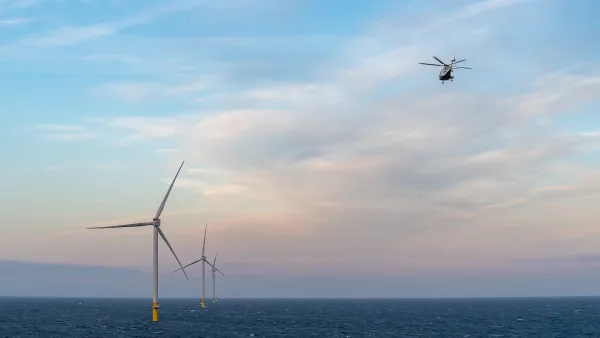
California presses forward on offshore wind
The state is taking steps to prepare its grid and port infrastructure for offshore wind projects despite the federal government's pushback on the technology.
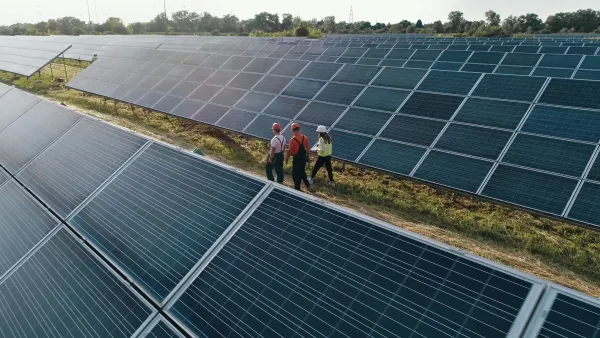
Study: States approved 90% of renewable energy projects between 2018 and 2024
Ohio had the highest rejection rate for wind and solar proposals.
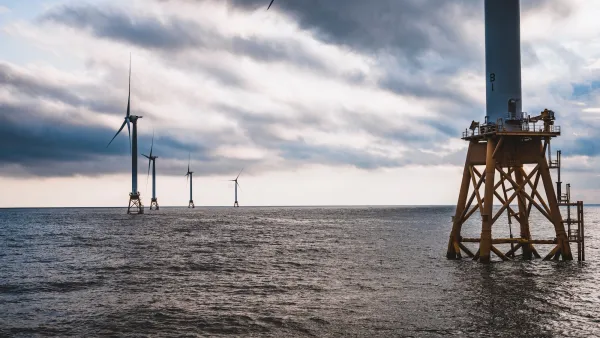
Trump Administration to Pay Energy Firm $1 Billion to Kill Wind Farms in Favor of Fossil Fuel Projects
TotalEnergies will forfeit its lease on two proposed wind energy projects off the coasts of New York and North Carolina.

Planetizen Federal Action Tracker
A weekly monitor of how Trump’s orders and actions are impacting planners and planning in America.

Amtrak, CN end decades-long dispute with eight-year agreement
The new operating agreement establishes an updated framework for the companies to work together, including processes to resolve disputes.

Judges permit Denver to divert 77,000 acre feet from the Colorado River for reservoir expansion
Overuse and climate change have caused the Colorado River’s water levels to plummet.

Boston has spent millions making the Green Line more accessible — and there’s no end in sight
While the city has invested millions into expanding and adding platforms to the Green Line to make it more accessible, new train cars set to arrive next year will be too tall for disabled passengers to board without raising the current platforms.

Idaho may see an 18% drop in federal surface transit funding — the largest estimated cut in the US
Transit systems in rural communities are much more reliant on federal funding to provide their services.

How ‘post-disaster gentrification’ alters neighborhoods after natural calamities
After hurricanes, fires or other calamities, the original residents of a community are often replaced by younger, wealthier residents.

FREE Course: Walkable City 1: Why Walkability?
After describing his path towards focusing on walkability as the essence of good planning, Jeff Speck marches through his five principal reasons for making more walkable places.
Reinventing Malls: Planning Alchemy—Turning Gray Fields Into Gold
The course focuses on the opportunities and imperatives that shape reinvention of mall sites.

City of Wisconsin Rapids
Harvard University Graduate School of Design
KFH Group Inc.
The Architects Foundation
University of Cincinnati Online
The Pocatello Development Authority
The Urban Renewal Agency of the City of Pocatello