The city of Washington D.C. is trying to get ready for the Presidential Inauguration -- likely to be the largest gathering of people in U.S. history.


"Nobody knows for sure how many people will descend on Washington, D.C., this month to witness Barack Obama's presidential inauguration. Mayor Adrian Fenty has put the number between 3 and 5 million. Others say it will be closer to the 1.2 million who came for Lyndon B. Johnson's inaugural in 1964. What is clear is that January 20, and perhaps the three-day weekend preceding it, will bring a crush of humanity into the capital city. If the numbers turn out on the high end of the range, it may represent the largest single gathering of people in American history."
"Even for a city that is accustomed to handling big marches and events, this is a bit much. The local infrastructure and services are likely to be stretched past their limits. For example, Metro, the local subway system, has never carried more than 855,000 passengers in a single day. That record is certain to be shattered. Metro plans to put every functioning rail car into service, and to run trains at rush-hour frequencies all day long. Still, officials are imploring anyone coming to the festivities from within a two-mile radius to plan on getting there by foot."
Read the full story: One Crowded Capital
Booze It Up for Barry and Save the Capitol
When President-elect Barack Obama is inaugurated on January 20, the city of Washington D.C. is likely to be the most lively, exciting and vibrant city in the world. Millions will be there. Hotels for miles around are booked full, couches across the city will be crashed upon, and many in the city are expecting the party to last for days. City officials are doing what they can to make sure the party does indeed happen.
Stepping Up Security for the Inauguration
Security considerations are already making a huge impact in Washington D.C. as the Capitol readies for the inauguration of President-elect Barack Obama.
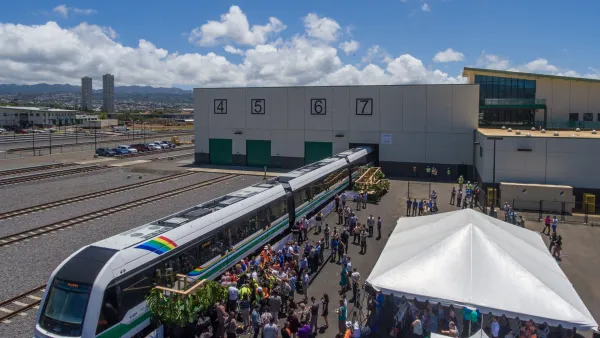
From robotaxis to robotrains: LA, DC weigh driverless transit
If approved, the projects will take years to implement and face financial and technical hurdles.

Planetizen Federal Action Tracker
A weekly monitor of how Trump’s orders and actions are impacting planners and planning in America.

Eastern Nebraska is running out of electricity
Data centers and electrification are straining eastern Nebraska’s grid, throttling economic development.

Study reveals best places in the U.S. for cycling, walking
New research from Streetlight Data examines bicycle and pedestrian miles per capita in the 100 largest U.S. cities by population.

DSA members accuse Mamdani of 'abandoning values' over housing redevelopment
New York City's mayor plans to replace about 2,000 units of public housing with private, mixed-income housing.

All sides of BRT debate unhappy with CDOT’s most recent move
The Colorado Department of Transportation is no longer considering center-running bus lanes for Colorado Boulevard.

Massachusetts bogs generate both power, and cranberries
Putting solar panels above farmland is one way Massachusetts is advancing toward its goal of net-zero carbon emissions by 2050.

FREE Course: Walkable City 1: Why Walkability?
After describing his path towards focusing on walkability as the essence of good planning, Jeff Speck marches through his five principal reasons for making more walkable places.
Reinventing Malls: Planning Alchemy—Turning Gray Fields Into Gold
The course focuses on the opportunities and imperatives that shape reinvention of mall sites.

City of Rosemead
Rutgers University, Edward J. Bloustein School of Planning and Public Policy
One Hundred Miles
University of Michigan School for Environment and Sustainability (SEAS)
Hunter College, City University of New York (CUNY)
The Architects Foundation
City of Cambridge
The Pocatello Development Authority
The Urban Renewal Agency of the City of Pocatello