As President Elect Obama delivers his weekly address via YouTube, half of all Americans don't have the broadband access necessary to watch.


"A survey by the Information Technology & Innovation Foundation ranked the U.S. 15th on household broadband penetration, having slipped from fourth place in 2001, according to the Organization for Economic Cooperation & Development. (Denmark ranked No. 1.)
In a Dec. 6 speech, Obama called the current state of U.S. broadband access "unacceptable" and said plans to "renew our Information Superhighway" would be a priority of his Administration. To deliver, Obama will need to address the wide swaths of the U.S. that remain unconnected. In some places-most of them rural areas with low population density-people who are willing to pay for service can't get it because telecom providers can't justify the necessary investment.
In the case of the urban poor, service may be readily available, but many families can't afford the $30 to $50 it costs each month to get broadband. Many also lack computers at home. Among households with an annual income of $50,000 or less-about half the country-only 35% have broadband service, according to Free Press, a technology advocacy group. Households with annual incomes above $50,000 are more than twice as likely to have broadband service. "
Read the full story: Bringing Broadband to the Urban Poor

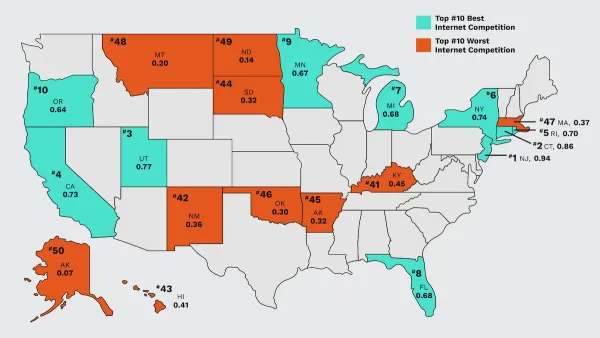
Do You Live in an ISP Monopoly?
Almost 9 million Americans live in an area with only one option for internet providers.
Mapping the Gap Between Broadband Access and Broadband Subscription
Not everyone that has access to high-quality Internet infrastructure is making use of it.
L.A.'s Next Superhighway
Could Los Angeles get a private company to spend $3 billion to $5 billion to connect every residence and business in the city to a fiber broadband network? City leaders seem to think so, and are planning to move forward with an RFP.

Planetizen Federal Action Tracker
A weekly monitor of how Trump’s orders and actions are impacting planners and planning in America.

California plans to bury El Niño’s downpour
If the state plays its cards right, it may be able to store a billion acre-feet of El Niño’s water in aquifers.

Chicago breaks ground on $3 billion megadevelopment
The new neighborhood, titled Foundry Park, will one day host 3,700 residences.

California High-Speed Rail Authority CEO resigns after $600,000 scandal
Under Ian Choudri, the authority used taxpayer dollars to fund first class flights and trips to nightclubs.

Want to study the Missouri River? Soon, you may need unanimous approval from 10 states
Legislation would require 10 governors’ permission to study or build projects moving water outside the basin.

Desperate measures: Advocates weigh draining Lake Powell to fill Colorado River
Draining the reservoir could reduce evaporation losses by a couple hundred thousand acre-feet.

FREE Course: Walkable City 1: Why Walkability?
After describing his path towards focusing on walkability as the essence of good planning, Jeff Speck marches through his five principal reasons for making more walkable places.
Reinventing Malls: Planning Alchemy—Turning Gray Fields Into Gold
The course focuses on the opportunities and imperatives that shape reinvention of mall sites.

City of Rosemead
Rutgers University, Edward J. Bloustein School of Planning and Public Policy
One Hundred Miles
Hunter College, City University of New York (CUNY)
The Architects Foundation
University of Cincinnati Online
City of Cambridge
Montrose County
The Pocatello Development Authority