For decades, development in Maine sprawled away from cities and across the landscape. The flailing economy may be the only thing that can change the pattern.


"Population changes for 22 of the state's service-center communities show that the steady flow of people away from the cities during the 1990s has ebbed dramatically since 2000. A few communities, such as Bangor, Waterville and Belfast, have begun gaining population.
A similar analysis of every community in fast-growing York and Cumberland counties shows that the rapid pace of development in suburbs and outlying towns has cooled in recent years. The York County town of Dayton, for example, grew by more than 50 percent from 1990 to 2000. So far this decade, the growth rate there is less than 12 percent.
These comparisons were compiled by the Maine State Planning Office. Taken together, they hint at changes in development patterns that have endured in Maine for half a century."
Thanks to Christian McNeil
Read the full story: Is Maine kicking its sprawl habit?
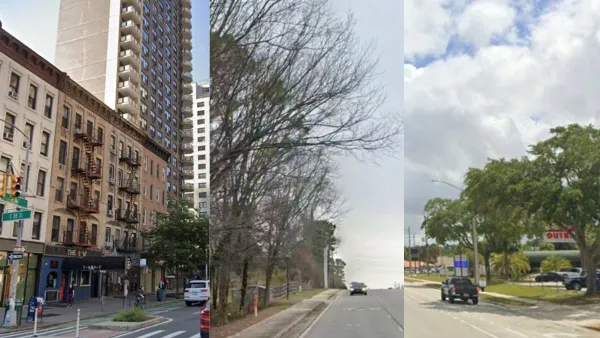
A Transect of sprawl
A development pattern this lifestyle-defining deserves its whole own classification system.

What the fall of earth's largest pre-industrial city can teach us about urban sprawl
Angkor was a low-density metropolis. It lasted six centuries, until it could no longer maintain its infrastructure in a changing climate. Today, it offers planners a sobering warning about the risks of dispersed urban living.

Nearly a third of US housing is in the wildland-urban interface — and at growing risk of wildfire
As suburbs increasingly mingle with undeveloped land, homes face a higher risk from destructive fires.

Planetizen Federal Action Tracker
A weekly monitor of how Trump’s orders and actions are impacting planners and planning in America.

California plans to bury El Niño’s downpour
If the state plays its cards right, it may be able to store a billion acre-feet of El Niño’s water in aquifers.

Desperate measures: Advocates weigh draining Lake Powell to fill Colorado River
Draining the reservoir could reduce evaporation losses by a couple hundred thousand acre-feet.

US buildings threatened, destroyed by fires set to triple by 2060
Researchers found a high fire risk for socioeconomically vulnerable neighborhoods in the American West.

LA residents may be allowed to paint their own crosswalks
Councilwoman Katy Yaroslavsky put out a motion instructing the Los Angeles Department of Public Transportation to study the feasibility of allowing volunteers to paint crosswalks.

Dallas moves to overhaul its zoning code
The city's zoning reform will allow more multi-family and mixed-use developments.

FREE Course: Walkable City 1: Why Walkability?
After describing his path towards focusing on walkability as the essence of good planning, Jeff Speck marches through his five principal reasons for making more walkable places.
Reinventing Malls: Planning Alchemy—Turning Gray Fields Into Gold
The course focuses on the opportunities and imperatives that shape reinvention of mall sites.

City of Rosemead
Rutgers University, Edward J. Bloustein School of Planning and Public Policy
One Hundred Miles
Hunter College, City University of New York (CUNY)
The Architects Foundation
University of Cincinnati Online
City of Cambridge
Montrose County
The Pocatello Development Authority