Los Angeles' budget shortfall could mean sending its zoo's only elephant to a Northern California sanctuary. Over time, funding for city services are also predicted to get slashed.


"The City Council voted Wednesday to halt further funding for the planned $42 million Pachyderm Forest exhibit at the Los Angeles Zoo while it debates what should happen to the partially completed exhibit, which already has cost $12 million. The vote came two days after the council's budget committee recommended canceling the project as a cost-saving measure.
The move is an example of how shrinking city budgets are forcing hard choices that can kick up local ire.
Declining tax revenues, triggered by the recession, mean Los Angeles is facing an expected $110 million shortfall in its $7 billion budget, which runs through June 30. The expected shortfall could surpass $300 million next year, prompting the city to discuss a wide variety of measures, such as cutting funding for crossing guards, public libraries and numerous other services.
Over the next few weeks, committee members will review options for the exhibit that include possibly privatizing the zoo.They also will be deliberating the fate of 21-year-old Billy, and whether to transfer him out of the zoo."
Read the full story: City Budget Crunch Hits the Zoo
An Inside Look at Making L.A.'s Difficult Decisions in a Time of Austerity
LA Councilmember Paul Krekorian discusses reducing the city's budget deficit, the impacts his decisions will have on core services and civil servants, and the tolls that come with taking on a budget crisis during a period of fiscal austerity.

Los Angeles just elected an urban planner as its mayor
Transportation analysts are optimistic that Raman will be more aggressive in addressing transit issues than Bass.
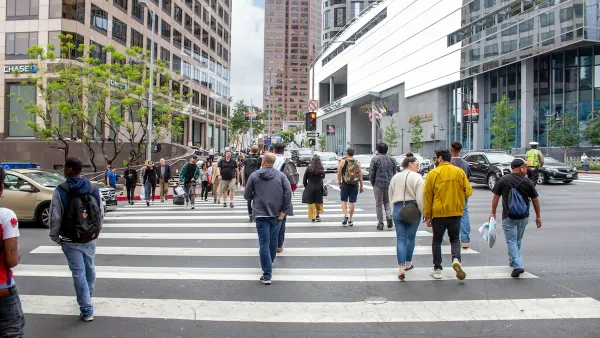
LA residents may be allowed to paint their own crosswalks
Councilwoman Katy Yaroslavsky put out a motion instructing the Los Angeles Department of Public Transportation to study the feasibility of allowing volunteers to paint crosswalks.

Desperate measures: Advocates weigh draining Lake Powell to fill Colorado River
Draining the reservoir could reduce evaporation losses by a couple hundred thousand acre-feet.

Eastern Nebraska is running out of electricity
Data centers and electrification are straining eastern Nebraska’s grid, throttling economic development.

Malls are becoming the midtowns of the future
Mall and office park redevelopments are a generational opportunity to create new nodes of urbanity.

NYC breaks ground on anti-flooding infrastructure project
New York City's new system will reduce stormwater flows to local sewers by 90%.

One Kentucky town’s secret to affordable housing
The Smoketown Community Land Trust has already built seven affordable homes for community members.

Houston gains petal-shaped cooling infrastructure to make streets more ‘delightful’
The city has installed the pavilions along 15 blocks in Houston.

FREE Course: Walkable City 1: Why Walkability?
After describing his path towards focusing on walkability as the essence of good planning, Jeff Speck marches through his five principal reasons for making more walkable places.
Reinventing Malls: Planning Alchemy—Turning Gray Fields Into Gold
The course focuses on the opportunities and imperatives that shape reinvention of mall sites.

City of Rosemead
Rutgers University, Edward J. Bloustein School of Planning and Public Policy
One Hundred Miles
University of Michigan School for Environment and Sustainability (SEAS)
Hunter College, City University of New York (CUNY)
The Architects Foundation
City of Cambridge
Montrose County
The Pocatello Development Authority