The idea of city autonomy is increasingly unrealistic, according to a new book by University of Western Ontario professor Andrew Sancton.


"Not since the emergence of Jane Jacobs, the ultimate target of Prof. Sancton's respectful attack, has such clear, empirical thinking invaded this woolly realm. The fact the author ends up endorsing a status quo in which cities remain the 'creatures' of senior governments in no way diminishes his argument's originality and importance."
"Although declaring himself sympathetic to concerns that unresponsive central governments are stifling urban progress, Prof. Sancton punctures "the inflated rhetoric" and 'confusions' he finds in the arguments made for greater urban autonomy, in particular those enunciated by 'Jane Jacobs and her Toronto followers.' The correction is needed, he writes, 'if for no other reason than that [such arguments] divert valuable resources to fruitless undertakings, much like searching for the end of the rainbow.'"
"The basic problem such thinking ignores, according to Prof. Sancton, is the reality of unchanging borders. 'Boundaries fatally limit the capacity of cities to be self-governing,' he writes. Even if it were possible to draw new borders for a modern city state within an existing nation or province - not, according to the author - the urban growth such borders are meant to support would instantly render them obsolete."
Read the full story: Urban autonomy a pipe dream given ever-changing boundaries


What Are America's Fastest-Growing Cities?
Views about urban growth and decline often rely on statistics for metropolitan regions rather than cities proper. Here, Richard Florida looks at the fastest- and slowest-growing cities in America, separate from their metro areas.
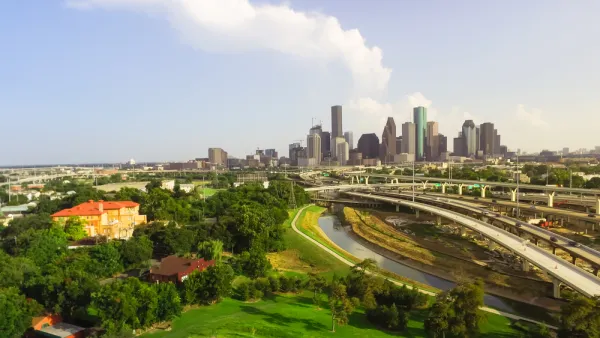
The Boundaries of Houston Don't Match the Perception of Houston
A more-than-6oo-square-mile city can get hard to map in our minds, especially when it blends so seamlessly into surrounding cities.
Examining the Income Inequality of Cities and Metro Areas
A rising tide doesn't necessarily lift all boats—even in a time of (mostly) decreasing income inequality at the city level.

Planetizen Federal Action Tracker
A weekly monitor of how Trump’s orders and actions are impacting planners and planning in America.

The state-sanctioned urbicide of Austin
People don’t kill cities. Freeways do.

US to reduce Colorado River water deliveries to Mexico
A new Colorado Treaty amendment reduces Mexico’s Colorado River water allocation by 250,000 acre feet.

Nation's most wind-powered state turns to coal as data centers increase energy demand
For the first time in decades, Iowa has increased its generation of coal power.

NYC cools commuters with city's first rain garden above a bus stop
New York City officials say the plants in the rain garden can absorb 16 gallons of rainwater during heavy storms.

Brightline West’s future may rely on $6 billion federal loan
The company has until Nov. 2 to make a $400 million equity investment into its proposed high-speed rail line.

FREE Course: Walkable City 1: Why Walkability?
After describing his path towards focusing on walkability as the essence of good planning, Jeff Speck marches through his five principal reasons for making more walkable places.
Reinventing Malls: Planning Alchemy—Turning Gray Fields Into Gold
The course focuses on the opportunities and imperatives that shape reinvention of mall sites.

Greater Baltimore Committee
Eagle County Government
Harvard University Graduate School of Design
The Architects Foundation
University of Cincinnati Online
The Pocatello Development Authority
The Urban Renewal Agency of the City of Pocatello
Journal of the American Planning Association