New office and apartment buildings in New York City are now mandated to provide a certain proportion of secure bike parking spaces.


"It will really transform the culture of the city, from a car-oriented city to a bike-oriented city," Planning Commissioner Amanda Burden said.
The Planning Commission will vote on the new rules after a public comment period lasting several months. If approved, the regulations will become part of city zoning law.
Mayor Michael Bloomberg's 2007 blueprint for a more sustainable city included a push for bike use.
Transportation officials are doubling the city's bike lanes and expect to have 420 miles of bike lanes in place by June 2009. They also are installing thousands of on-street bike racks, including some designed by Talking Heads singer and bicycling enthusiast David Byrne.
But surveys show that the lack of secure bicycle parking is a stumbling block preventing New Yorkers from cycling to work or to perform errands.
"We have found that one of the greatest impediments to more biking is the lack of space to store your bike long term at home and at work," Burden said.
Thanks to Jen Houser
Read the full story: NYC proposes bike parking rules in new buildings
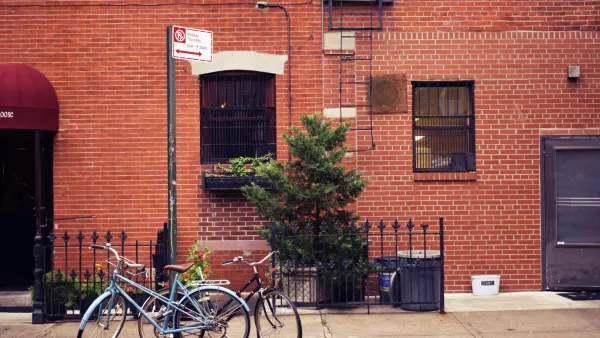
Report: Lackluster Bike Parking Reduces Cycling and Undermines Public Safety
Widely available, secure bike parking can go a long way toward encouraging cycling and keeping New Yorkers safe, a new report says.
NYC renovations for dangerous, ‘mercilessly crammed’ street delayed until 2027
Construction was supposed to begin this fall.
MTA sends Dem leaders a wish list to mend Trump’s damages
Requests include exempting new train and bus components from tariffs and increasing transit security funding.

Planetizen Federal Action Tracker
A weekly monitor of how Trump’s orders and actions are impacting planners and planning in America.

Eastern Nebraska is running out of electricity
Data centers and electrification are straining eastern Nebraska’s grid, throttling economic development.

Move over, LA: St. Louis gears up for Olympics, invests millions in downtown redevelopment
The Missouri city will host the 2028 Olympic soccer group stage and knockout matches.

Dallas releases zoning code overhaul to officials
The drafted overhaul is over 400 pages long.

NYC renovations for dangerous, ‘mercilessly crammed’ street delayed until 2027
Construction was supposed to begin this fall.

San Diego’s Midway Rising project gets greenlight from city council
The project looks to become the largest affordable housing development in California's history.

FREE Course: Walkable City 1: Why Walkability?
After describing his path towards focusing on walkability as the essence of good planning, Jeff Speck marches through his five principal reasons for making more walkable places.
Reinventing Malls: Planning Alchemy—Turning Gray Fields Into Gold
The course focuses on the opportunities and imperatives that shape reinvention of mall sites.

City of Rosemead
Rutgers University, Edward J. Bloustein School of Planning and Public Policy
One Hundred Miles
University of Michigan School for Environment and Sustainability (SEAS)
Hunter College, City University of New York (CUNY)
The Architects Foundation
City of Cambridge
The Pocatello Development Authority
The Urban Renewal Agency of the City of Pocatello