'Laneway housing'- known to many in the U.S. as 'granny units'- is a popular solution for creating more housing in dense Canadian cities like North Vancouver. In fact, Mayor Darrell Mussatto lives in one.


"As mayor of the City of North Vancouver, Darrell Mussatto sure knows how to talk up the benefits of laneway housing when he's making a pitch for his municipality to allow this type of accommodation. About to win reelection by acclamation-no one stepped forward to challenge him in November's civic election-he is well prepared to argue in support of these cottages, which are built at the back of a property, from an environmental-sustainability perspective.
But what may ultimately be Mussatto's most persuasive argument is that he himself has lived in one for the last six years. In a phone interview, the mayor recalled that he moved out of the family duplex in 2002 so his parents could move into his half. His brother and sister-in-law occupy the other half of the house. He then had a coach house constructed at the back of the family lot.
'I think it's a wonderful thing,' Mussatto told the Georgia Straight. 'I'm able to check on my parents every day, and they can check on me every day.'"
Read the full story: Laneway housing could ease pressures
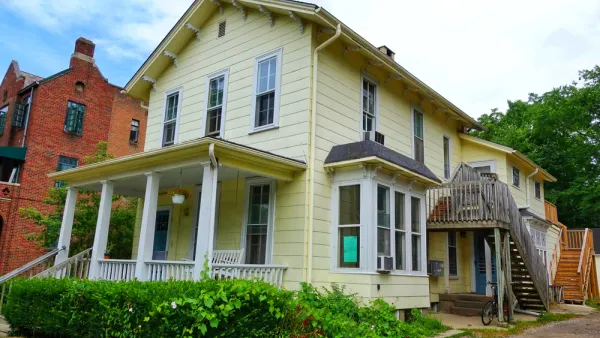
Citing Lack of ADU Development, Ann Arbor to Refine its ADU Ordinance
After legalizing accessory dwelling units in 2016, the city of Ann Arbor hasn't added many accessory dwelling units. Some regulations designed to limit the number of ADUs developed have made the building type impossibly cost prohibitive.
Little House on the Laneway
Vancouver's liberalized laneway housing zoning is seen as a cost-effective and easy way to densify, make housing more affordable and reduce the city's carbon footprint. But not everyone is on board.
Invasion of the Granny Pods
The Rev. Kenneth Dupin of Virginia wanted to find a way to keep elderly folks independent and near their families while providing the care they need. So he invented the MEDCottage, and is working with cities to change zoning to allow it.

Washington state to charge fee to drivers with fuel-efficient cars
Revenue from the fee will go towards supporting the state’s highways.

Illinois considers spending $1 billion in taxpayer money on data center
A quantum computing campus and data center are currently under construction in Chicago.

Trump to blast ‘hydrocarbon highway’ through ‘world’s longest art gallery’
Environmental and historic preservation groups are suing to stop the project.

NYC, state sue feds over mixed-immigration-status housing assistance rule
The state’s lawsuit argues that the rule change violates the Administrative Procedure Act.

Michigan to turn neighborhood into virtual power plant
Residents will soon be able to divert their excess energy to the grid in exchange for compensation.

Data center, mining project swarm to long-awaited Alaska railroad line
The state-owned railroad approved final plans for the spur line this week; the project is expected to cost $311 million, mostly funded by the federal government

FREE Course: Walkable City 1: Why Walkability?
After describing his path towards focusing on walkability as the essence of good planning, Jeff Speck marches through his five principal reasons for making more walkable places.
Reinventing Malls: Planning Alchemy—Turning Gray Fields Into Gold
The course focuses on the opportunities and imperatives that shape reinvention of mall sites.

City of Charlotte
City of Rosemead
Rutgers University, Edward J. Bloustein School of Planning and Public Policy
University of Michigan School for Environment and Sustainability (SEAS)
Hunter College, City University of New York (CUNY)
The Architects Foundation
University District Partnership