The State Department of Transportation fears that makeshift memorials for killed motorists will distract drivers, and has offered families public signs as alternatives.


"In a small storage shed tucked behind a highway maintenance facility in Wyoming, dozens of monuments to the state's dead motorists lie stacked against one another like discarded props from an old movie set waiting to be used again.
Some are made from wood, others from steel bars or wire, but all the memorials are vestiges of a new statewide effort to remove them from public roads.
'I think they would make a remarkable art exhibit,' said Ross Doman, a public liaison officer for the State Department of Transportation, running his hands over a large wooden cross bearing the name of Monte Robbins, who was killed nearly a decade ago on an interstate highway east of Laramie."
"No U.S. law specifically addresses roadside memorials, and policies differ by state. In Wyoming, officials decided to allow structures that were put up before 2003 to remain standing for five additional years, a period that ended in April. On Oct. 3, workers fanned out across the state to remove the nearly 300 remaining memorials from roadsides and highway medians.
So far, only 16 of the removed memorials have been claimed. The rest are stored at Transportation Department offices around the state."
Read the full story: Wyoming is putting roadside monuments to rest
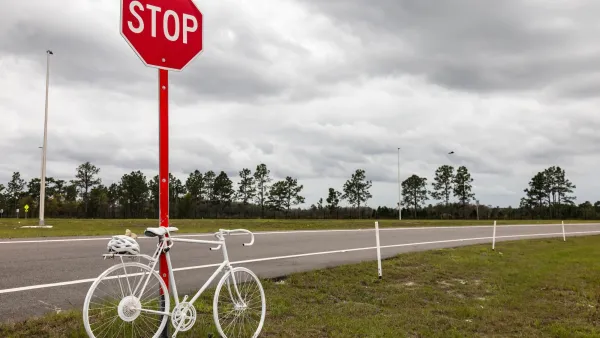
Landscapes of love and loss
As urban planners, every piece of infrastructure we build is a memorial — whether we know it or not.

These Bear Safety Signs Illustrate the Impact of Good Design
What makes a sign effective?
Supreme Court Case Could Transform Sign Regulations
If the Supreme Court upholds a lower court decision, cities could lose a long-standing right to regulate 'off-premises' billboards.

Planetizen Federal Action Tracker
A weekly monitor of how Trump’s orders and actions are impacting planners and planning in America.

California plans to bury El Niño’s downpour
If the state plays its cards right, it may be able to store a billion acre-feet of El Niño’s water in aquifers.

Desperate measures: Advocates weigh draining Lake Powell to fill Colorado River
Draining the reservoir could reduce evaporation losses by a couple hundred thousand acre-feet.

Los Angeles just elected an urban planner as its mayor
Transportation analysts are optimistic that Raman will be more aggressive in addressing transit issues than Bass.

Mamdani’s pied-à-terre tax survives legal challenge
A panel of judges found that the plaintiffs failed to demonstrate injury as a result of New York City's implementation of the tax.

Eastern Nebraska is running out of electricity
Data centers and electrification are straining eastern Nebraska’s grid, throttling economic development.

FREE Course: Walkable City 1: Why Walkability?
After describing his path towards focusing on walkability as the essence of good planning, Jeff Speck marches through his five principal reasons for making more walkable places.
Reinventing Malls: Planning Alchemy—Turning Gray Fields Into Gold
The course focuses on the opportunities and imperatives that shape reinvention of mall sites.

City of Rosemead
Rutgers University, Edward J. Bloustein School of Planning and Public Policy
One Hundred Miles
University of Michigan School for Environment and Sustainability (SEAS)
Hunter College, City University of New York (CUNY)
The Architects Foundation
City of Cambridge
Montrose County
The Pocatello Development Authority