Before the fiscal crisis, there was the global climate crisis. After the fiscal crisis, we’ll still have the global climate crisis — for the rest of our lives.


"A recent surge in emissions from such rapidly industrializing countries as China, India and Brazil makes the challenge even tougher. Those nations aren't likely to consider significant cutbacks unless the nations with the biggest per capita carbon emission rates - especially the United States - undertake serious, sweeping efforts themselves."
"There is hope: regional planners in recent years have laid out a 'Chicagoland' vision that would help carbon cutbacks - guiding growth into city and town centers and along transit corridors, protecting open space and farmland, promoting walking and biking.
True regionalism is perking in Northern California, where three mayors - Chuck Reed of San Jose, Gavin Newsom of San Francisco, and Ron Dellums of Oakland - have just forged, with business and civic leaders, a Bay Area Climate Change Compact with goals ranging from 20,000 'green collar' jobs to big boosts for renewable energy."
Thanks to Scott Ulrich
Read the full story: States, Cities Step Up Climate Change Responses

Who pays when a remote Alaska village can no longer stay?
A year after ex-Typhoon Halong, the struggle for two communities to find safer ground has become part of a national debate over who should bear the costs of the climate crisis.

'Something we’ve never seen before:' rising utility rates could strain city finances nationwide
Data centers, climate change and other factors have caused utility rates in the United States to increase by 38% since 2020.
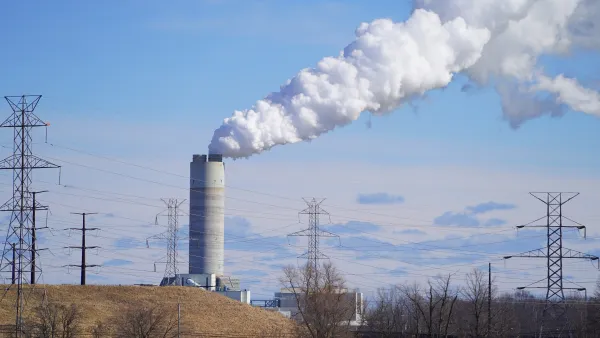
EPA erases limits on planet-warming pollution from power plants
Under Monday’s plan, power plants would still have some limits on how much mercury, arsenic and other contaminants they can emit.

Planetizen Federal Action Tracker
A weekly monitor of how Trump’s orders and actions are impacting planners and planning in America.

Eastern Nebraska is running out of electricity
Data centers and electrification are straining eastern Nebraska’s grid, throttling economic development.

Study reveals best places in the U.S. for cycling, walking
New research from Streetlight Data examines bicycle and pedestrian miles per capita in the 100 largest U.S. cities by population.

Why does it take an emergency for the U.S. to expedite infrastructure projects?
In June 2023, Philadelphia repaired a melted interstate in 12 days thanks to an emergency order.

Federal government nominates new FTA administrator
Mark Aesch is currently the founder and CEO of a transportation management consulting firm.

Developers reveal $10 billion stadium plan as ‘Hail Mary’ to keep Bears in Chicago
The plan would also boast a public park, high- and mid-rise buildings and a youth sports complex.

FREE Course: Walkable City 1: Why Walkability?
After describing his path towards focusing on walkability as the essence of good planning, Jeff Speck marches through his five principal reasons for making more walkable places.
Reinventing Malls: Planning Alchemy—Turning Gray Fields Into Gold
The course focuses on the opportunities and imperatives that shape reinvention of mall sites.

City of Charlotte
City of Rosemead
Rutgers University, Edward J. Bloustein School of Planning and Public Policy
University of Michigan School for Environment and Sustainability (SEAS)
Hunter College, City University of New York (CUNY)
The Architects Foundation
City of Cambridge
The Pocatello Development Authority
The Urban Renewal Agency of the City of Pocatello