John Barber laments cities' tendency to (rightfully) favor environmental consciousness over aestheticism. Low-carbon street lighting is the latest eco-trend to retrofit, and potentially blight, the streets of Toronto.


"But you never know: Traditionalists frustrated the first green-inspired assault on the old acorn [luminaire, the traditional Toronto street light] back in the 1990s, when the case against it was even stronger than it is today.
At the time, the old city of Toronto was the only municipality anywhere still lighting its streets with grossly inefficient incandescent bulbs, which it kept for mere aesthetic reasons: Its streets at night were uniquely gorgeous, and the only efficient alternative at the time - sodium-vapour lights - were then and remain hideous.
With the greens barking for efficiency, the old city pioneered its own disruptive technology: Traditional acorns powered by metal-halide lamps giving off a bright, white light. Tests showed that the new-old rig outperformed all the latest technology available at the time. Installed widely throughout the central city, the metal-halide acorns still manage to recall the soft-lit romance of yore.
But LED lighting is more efficient still, renewing demands for change. And the old Toronto, in which aesthetics sometimes mattered, is a long-forgotten conceit."
Read the full story: Against the environmentalist, aesthetes have no hope
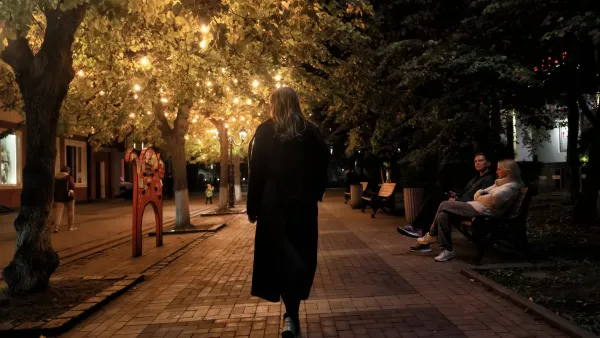
How urban design can deter crime
Well-designed public spaces and good lighting can prevent crime and make residents feel safer.
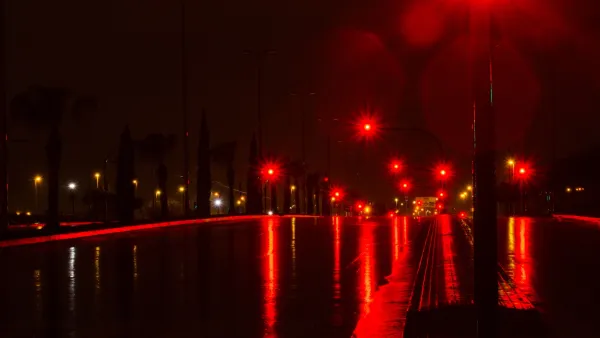
Danish Suburb Introduces Red Streetlights to Protect Nocturnal Species
The town of Gladsaxe is using red-spectrum LEDs to illuminate streets where bat species congregate.
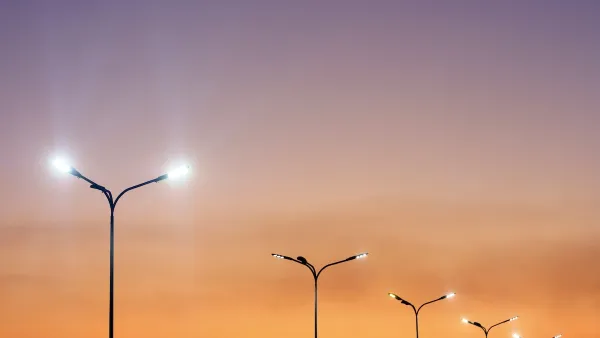
How Smart Street Lights Can Help Cities Achieve Sustainability Goals
Switching to energy-efficient LEDs and using tech to program when and how street lighting operates can save cities millions in electricity expenses and bring down carbon emissions.

Planetizen Federal Action Tracker
A weekly monitor of how Trump’s orders and actions are impacting planners and planning in America.

California plans to bury El Niño’s downpour
If the state plays its cards right, it may be able to store a billion acre-feet of El Niño’s water in aquifers.

Desperate measures: Advocates weigh draining Lake Powell to fill Colorado River
Draining the reservoir could reduce evaporation losses by a couple hundred thousand acre-feet.

US buildings threatened, destroyed by fires set to triple by 2060
Researchers found a high fire risk for socioeconomically vulnerable neighborhoods in the American West.

LA residents may be allowed to paint their own crosswalks
Councilwoman Katy Yaroslavsky put out a motion instructing the Los Angeles Department of Public Transportation to study the feasibility of allowing volunteers to paint crosswalks.

Dallas moves to overhaul its zoning code
The city's zoning reform will allow more multi-family and mixed-use developments.

FREE Course: Walkable City 1: Why Walkability?
After describing his path towards focusing on walkability as the essence of good planning, Jeff Speck marches through his five principal reasons for making more walkable places.
Reinventing Malls: Planning Alchemy—Turning Gray Fields Into Gold
The course focuses on the opportunities and imperatives that shape reinvention of mall sites.

City of Rosemead
Rutgers University, Edward J. Bloustein School of Planning and Public Policy
One Hundred Miles
Hunter College, City University of New York (CUNY)
The Architects Foundation
University of Cincinnati Online
City of Cambridge
Montrose County
The Pocatello Development Authority