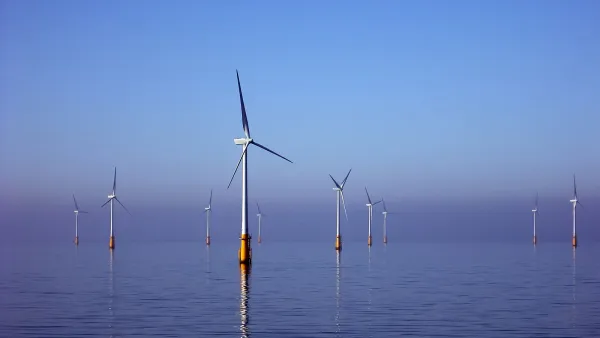
In order to reduce New York City's dependence on natural gas, Mayor Bloomberg is proposing an offshore wind farm and skyscraper-mounted turbines.


"[New York Mayor Michael] Bloomberg outlined plans that could result in placing large wind turbines atop skyscrapers and bridges, augmented by a wind farm in the middle of the ocean, several miles off the Manhattan coast. Such a move would dramatically alter the city's iconic skyline, prompting several media outlets to lampoon the idea, grafting images of windmills onto the Brooklyn Bridge and the Empire State Building.
Josh Magee, research director at Emerging Energy Research in Cambridge, Mass., said some of these proposals, like the offshore farms, are more viable than others, because of the city's coastal positioning and the prevailing wind currents. Although this power can be expensive, it would provide the city with a natural hedge against volatile price swings in the natural-gas market, on which New York relies heavily for its power needs.
The notion of affixing windmills on the top of skyscrapers, however, appears to be far-fetched, given the turbulence and wind shear they would face at this altitude."
Read the full story: New York mayor tilts at windmills

Northern California Port Seeks Offshore Wind Lease
The Port of Humboldt has proposed a plan to modernize its facilities to accommodate offshore wind energy production, hoping to stimulate the local economy and create sustainable jobs.
Can Maine Follow Denmark to Energy Independence?
Visitors from small islands off the coast of Maine traveled to Samsø, a larger island off the coast of Denmark, to learn how to emulate its transformation into a model of renewable energy.
Windfarm Concept Inspired by Schools of Fish
Current wind farm technology requires a lot of space between blades. A new report proposes that "counter-rotating vertical-axis wind turbines" would draw power more efficiently on less land.

Planetizen Federal Action Tracker
A weekly monitor of how Trump’s orders and actions are impacting planners and planning in America.

Amtrak, CN end decades-long dispute with eight-year agreement
The new operating agreement establishes an updated framework for the companies to work together, including processes to resolve disputes.

Judges permit Denver to divert 77,000 acre feet from the Colorado River for reservoir expansion
Overuse and climate change have caused the Colorado River’s water levels to plummet.

Northwest rail fans eager for Sept. 30 debut of Amtrak’s Airo fleet
Get ready for that new train smell and more seats. But they won’t go faster or run more frequently on the Cascades route in Washington and Oregon.

NYC DOT wants faster, more permanent street upgrades
The city is examining ways to build more concrete infrastructure without getting entangled in 'decades-long' projects.

'Something we’ve never seen before:' rising utility rates could strain city finances nationwide
Data centers, climate change and other factors have caused utility rates in the United States to increase by 38% since 2020.

FREE Course: Walkable City 1: Why Walkability?
After describing his path towards focusing on walkability as the essence of good planning, Jeff Speck marches through his five principal reasons for making more walkable places.
Reinventing Malls: Planning Alchemy—Turning Gray Fields Into Gold
The course focuses on the opportunities and imperatives that shape reinvention of mall sites.

Harvard University Graduate School of Design
KFH Group Inc.
Greater Baltimore Committee
The Architects Foundation
University of Cincinnati Online
The Pocatello Development Authority
The Urban Renewal Agency of the City of Pocatello