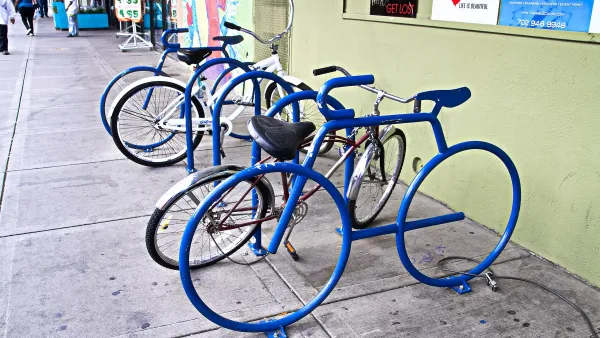
David Byrne, an avid cyclist in Manhattan, was asked to judge a bike rack design contest. Instead, he made his own designs, which have quickly gone up around the city.


"They were simple shapes to define different neighborhoods around the city: a dollar sign for Wall Street; an electric guitar for Williamsburg, Brooklyn; a car - "The Jersey" - for the area near the Lincoln Tunnel. "I said, ‘Well, this disqualifies me as a judge,' " he recalled, "but I just doodled them out and sent them in." He figured maybe they'd be used to decorate the contest Web site, nycityracks.wordpress.com.
Instead, much as when George W. Bush asked Dick Cheney to find him a vice president, Mr. Byrne ended up landing the job for which he was leading the search team. Well, almost: the competition for new standard racks is still on, but on Friday nine racks made from his own whimsical designs were installed around the city. 'They immediately responded, saying, 'If you can get these made, we'll put them through,'' he recalled. 'I was kind of shocked.'"
Read the full story: David Byrne, Cultural Omnivore, Raises Cycling Rack to an Art Form

Where's the nearest bike rack? This Las Vegas map shows you.
Because bike parking is often on private property, it's difficult for cyclists to know where they can find it.
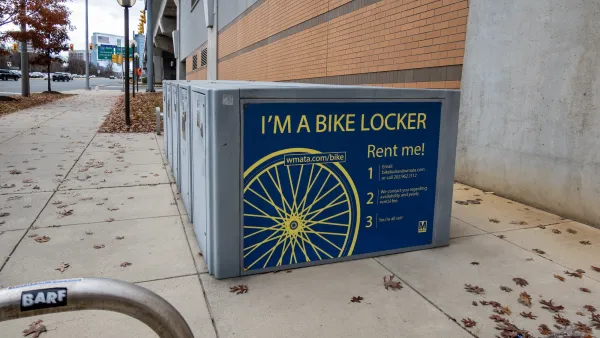
DC is Installing Hundreds of New Bike Lockers at Metro Stops
The WMATA’s push to better integrate bikes into their transit system includes hundreds of new secure bike lockers, repair stations, and train cars with dedicated space for bikes.
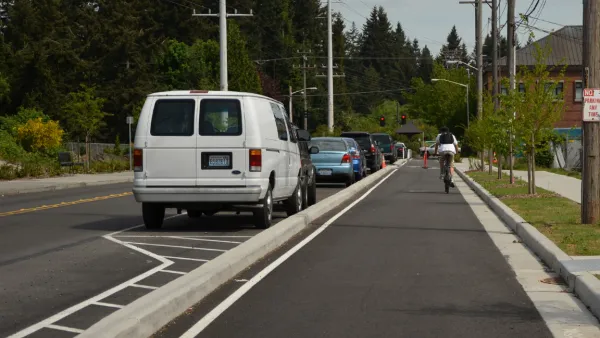
Jacksonville Adding New Bike Racks
The city will add dozens of new bike racks over the coming months to prevent bike theft and reduce sidewalk clutter.

Amtrak, CN end decades-long dispute with eight-year agreement
The new operating agreement establishes an updated framework for the companies to work together, including processes to resolve disputes.

Judges permit Denver to divert 77,000 acre feet from the Colorado River for reservoir expansion
Overuse and climate change have caused the Colorado River’s water levels to plummet.
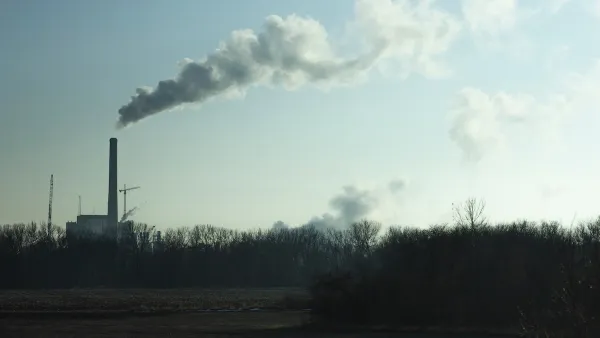
Nation's most wind-powered state turns to coal as data centers increase energy demand
For the first time in decades, Iowa has increased its generation of coal power.

Boston has spent millions making the Green Line more accessible — and there’s no end in sight
While the city has invested millions into expanding and adding platforms to the Green Line to make it more accessible, new train cars set to arrive next year will be too tall for disabled passengers to board without raising the current platforms.

Idaho may see an 18% drop in federal surface transit funding — the largest estimated cut in the US
Transit systems in rural communities are much more reliant on federal funding to provide their services.

How ‘post-disaster gentrification’ alters neighborhoods after natural calamities
After hurricanes, fires or other calamities, the original residents of a community are often replaced by younger, wealthier residents.

FREE Course: Walkable City 1: Why Walkability?
After describing his path towards focusing on walkability as the essence of good planning, Jeff Speck marches through his five principal reasons for making more walkable places.
Reinventing Malls: Planning Alchemy—Turning Gray Fields Into Gold
The course focuses on the opportunities and imperatives that shape reinvention of mall sites.

City of Wisconsin Rapids
Harvard University Graduate School of Design
KFH Group Inc.
The Architects Foundation
University of Cincinnati Online
The Pocatello Development Authority
The Urban Renewal Agency of the City of Pocatello