Globalization has spurned a renaissance in the formerly crime-ridden Colombian city of Medellin. But some worry that the city's improvements may only be temporary.


"This labyrinthine metropolis transformed over the course of a decade from a battlefield of drug lords, paramilitaries and leftist guerrillas into one of the safest, most dynamic cities in Latin America. Visionary inner-city renewal projects and a push to take back the lawless hillside slums by force deserve credit, but many here hail an unsung hero in Medellin's urban miracle -- globalization."
"Exports surged in the 1990s as the United States granted temporary trade preferences to Colombia, allowing many of its products to enter the world's largest market duty-free. They really took off after 2002, when Washington expanded that agreement to include Colombia's all-important textile sector."
"Yet the renaissance of a city best known outside Colombia for years as the base of Pablo Escobar and the Medellin cartel is entering a period of uncertainty that illustrates just how fragile such gains can be. The city's export industry has begun to slip backward, officials here say. It happens as Colombia and many developing nations are struggling to maintain their edge in the increasingly competitive world of global trade."
Read the full story: Sustaining the Medellin Miracle
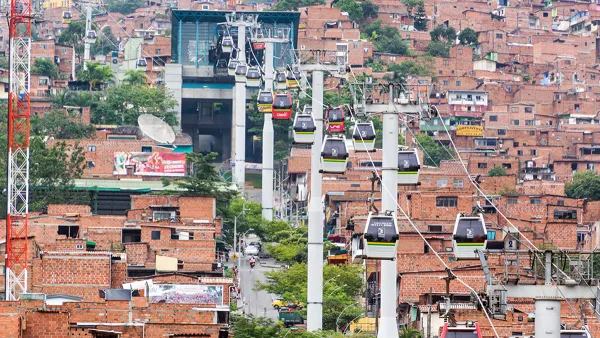
Infrastructure Investment for Public Safety: Lessons from Medellín
A natural experiment in Medellín indicates that infrastructural investments can reduce crime and improve perceptions of public safety.

Colombia's Carbon Neutral Christmas Wonderland
Medellín's spectacular holiday lights display draws thousands of tourists to Colombia's second-largest city every year. Few visitors are likely to realize that the energy intensive displays are carbon neutral.
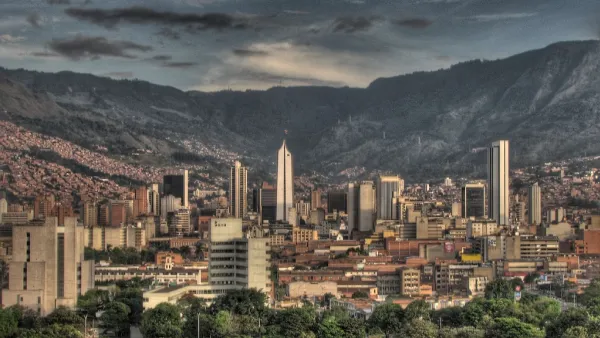
Medellin Chosen as 'Innovative City of the Year'
From an initial list of 200 candidates, Medellín, Colombia has been selected as the winner of The Wall Street Journal and Citi's “City of the Year” competition.

Planetizen Federal Action Tracker
A weekly monitor of how Trump’s orders and actions are impacting planners and planning in America.

California plans to bury El Niño’s downpour
If the state plays its cards right, it may be able to store a billion acre-feet of El Niño’s water in aquifers.

Desperate measures: Advocates weigh draining Lake Powell to fill Colorado River
Draining the reservoir could reduce evaporation losses by a couple hundred thousand acre-feet.

Mamdani’s pied-à-terre tax survives legal challenge
A panel of judges found that the plaintiffs failed to demonstrate injury as a result of New York City's implementation of the tax.

Eastern Nebraska is running out of electricity
Data centers and electrification are straining eastern Nebraska’s grid, throttling economic development.

Seattle passes record-breaking transit services expansion
Proposition 1 will double the city’s transit tax to add 95,000 more bus trips and preserve 180,000 bus trips annually.

FREE Course: Walkable City 1: Why Walkability?
After describing his path towards focusing on walkability as the essence of good planning, Jeff Speck marches through his five principal reasons for making more walkable places.
Reinventing Malls: Planning Alchemy—Turning Gray Fields Into Gold
The course focuses on the opportunities and imperatives that shape reinvention of mall sites.

City of Rosemead
Rutgers University, Edward J. Bloustein School of Planning and Public Policy
One Hundred Miles
University of Michigan School for Environment and Sustainability (SEAS)
Hunter College, City University of New York (CUNY)
The Architects Foundation
City of Cambridge
Montrose County
The Pocatello Development Authority