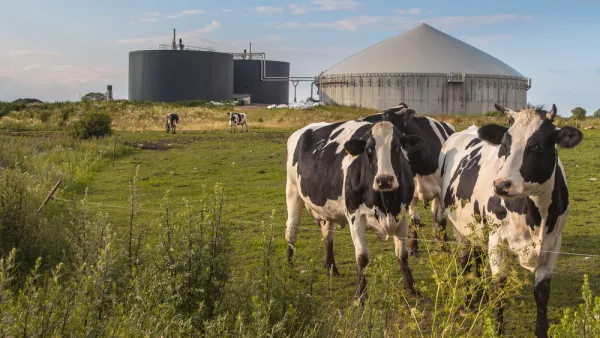
In an incredible recycling operation that reduces global warming, a waste hauler is building a facility to produce Liquefied Natural Gas from methane emitted from its California landfill to fuel its garbage trucks.


"Houston-based Waste Management Inc. and Linde North America, a German-based global natural gas producer, are working together to create what the two describe as the world's largest facility converting landfill gas to clean vehicle fuel." The Altamont landfill is outside Livermore in Alameda County, CA, and is scheduled to open next year.
"California's Air Resources Board and the state's Integrative Waste Management Board are among agencies that provided $1.6 million in grants to help fund the $15 million liquid natural gas plant."
"Waste Management already harnesses landfill gas to produce electricity at about 100 of its 280 landfills nationwide. This is the first time the company will convert landfill gas into liquid natural gas to power trucks, replacing the LNG that it trucks in from Arizona."
"Conventional natural gas is a fossil fuel, but natural gas derived from biomass, such as organic waste decomposing in landfills, is a renewable resource."
"Landfill gas – a mixture of half methane and half carbon dioxide – is collected, purified, compressed and supercooled to form liquid natural gas. Only methane is used to form the fuel. Some carbon dioxide is released into the air but under limits set by the state."
"The plant is expected to generate 13,000 gallons per day of the fuel, enough to power about 300 trucks. The company expects to reduce its greenhouse gas emissions by 30,000 tons a year using biogas."
From Oakland Tribune:
"The project is a "very significant step toward helping meet (Gov. Arnold) Schwarzenegger's new low-carbon fuel standard," Linda Adams, secretary of the California Environmental Protection Agency, said in a statement."
Read the full story: Waste Management to use landfill gas to power trucks


Former Landfill Doubles as Public Park, Energy Producer
Once the world’s largest dump, Freshkills Park now offers new city park space and powers local households with biofuel.
Renewable Natural Gas Makes Inroads in California, Oregon, and Missouri
What is expected to be the nation's largest dairy biogas operation opened in the Central Valley. To the north, Gov. Kate Brown signed the nation's first bill to establish goals to add renewable gas to pipelines, and pigs in Missouri also made news.
Pop Quiz: What's the Difference Between Aerobic Decomposition and Anaerobic Digestion?
Yes, one is with and the other without oxygen, and both divert waste from the landfill—but in terms of the end products, what is the advantage of anaerobic digestion? Simply put, does society face a shortage of compost or renewable energy?

Planetizen Federal Action Tracker
A weekly monitor of how Trump’s orders and actions are impacting planners and planning in America.

Amtrak, CN end decades-long dispute with eight-year agreement
The new operating agreement establishes an updated framework for the companies to work together, including processes to resolve disputes.

Judges permit Denver to divert 77,000 acre feet from the Colorado River for reservoir expansion
Overuse and climate change have caused the Colorado River’s water levels to plummet.

NYC DOT wants faster, more permanent street upgrades
The city is examining ways to build more concrete infrastructure without getting entangled in 'decades-long' projects.

'Something we’ve never seen before:' rising utility rates could strain city finances nationwide
Data centers, climate change and other factors have caused utility rates in the United States to increase by 38% since 2020.

Trump to overrule local leaders, lease millions of acres of America’s Pacific Island territories’ seafloors to mining companies
International law says that the Indigenous people of America’s territories have a right to prior and informed consent regarding projects that impact their countries.

FREE Course: Walkable City 1: Why Walkability?
After describing his path towards focusing on walkability as the essence of good planning, Jeff Speck marches through his five principal reasons for making more walkable places.
Reinventing Malls: Planning Alchemy—Turning Gray Fields Into Gold
The course focuses on the opportunities and imperatives that shape reinvention of mall sites.

Harvard University Graduate School of Design
KFH Group Inc.
Greater Baltimore Committee
The Architects Foundation
University of Cincinnati Online
The Pocatello Development Authority
The Urban Renewal Agency of the City of Pocatello