The New York City Department of Transportation and the Metropolitan Transit Authority unveiled the city's current Bus Rapid Transit program earlier this week, including a project that would "redefine the public realm" on Manhattan's 34th Street.


The 34th Street "Transitway" would direct all private vehicles away from the Central Business District while dedicating an entire block to buses and pedestrian plazas. The project would also link to new East River ferry service.
"DOT will repave and restripe for five lanes between Third and Ninth Avenues by the end of this year, with painted bus lanes on the north and south sides and three auto lanes in the center. Service hours will also be extended. Phase 2 calls for a 34th Street Transitway, closing the street to cars between Fifth and Sixth and installing pedestrian plazas. On either side of that block, there would be two lanes for cars heading in one direction -- toward the rivers -- while on the other half of the street, buses would have two extra-wide lanes separated from traffic. In other words, buses would constitute the only through traffic on 34th Street. According to Sadik-Khan, 34th Street BRT will eventually tie in to new East River ferry service (details to be announced next week)."
Thanks to Streetsblog
Read the full story: A Transit Miracle on 34th Street
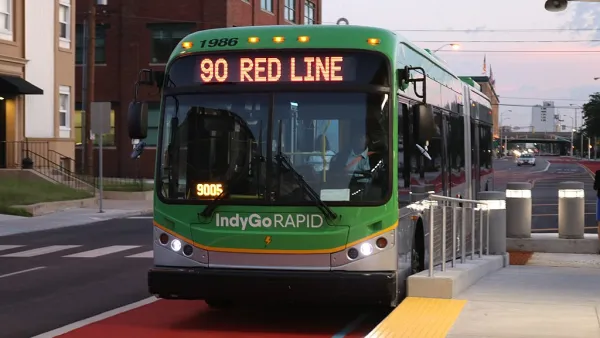
Indiana Once Again Considering Ban on Dedicated Transit Lanes
The proposed legislation would impact the construction of planned IndyGo Blue Line, the third phase of the city’s bus rapid transit system.
BRT on the Rise Globally
Bus rapid transit is growing in popularity throughout the world, though implementation is lacking in the U.S.

Experts Reject Florida Study That Killed St. Pete Bus Lane as ‘Incomplete,’ ‘Unfair’
A transit activist has filed a suit against FDOT, which used a a one-page study to justify removing a dedicated bus lane.

Planetizen Federal Action Tracker
A weekly monitor of how Trump’s orders and actions are impacting planners and planning in America.

California plans to bury El Niño’s downpour
If the state plays its cards right, it may be able to store a billion acre-feet of El Niño’s water in aquifers.

Desperate measures: Advocates weigh draining Lake Powell to fill Colorado River
Draining the reservoir could reduce evaporation losses by a couple hundred thousand acre-feet.

Los Angeles just elected an urban planner as its mayor
Transportation analysts are optimistic that Raman will be more aggressive in addressing transit issues than Bass.

Mamdani’s pied-à-terre tax survives legal challenge
A panel of judges found that the plaintiffs failed to demonstrate injury as a result of New York City's implementation of the tax.

Eastern Nebraska is running out of electricity
Data centers and electrification are straining eastern Nebraska’s grid, throttling economic development.

FREE Course: Walkable City 1: Why Walkability?
After describing his path towards focusing on walkability as the essence of good planning, Jeff Speck marches through his five principal reasons for making more walkable places.
Reinventing Malls: Planning Alchemy—Turning Gray Fields Into Gold
The course focuses on the opportunities and imperatives that shape reinvention of mall sites.

City of Rosemead
Rutgers University, Edward J. Bloustein School of Planning and Public Policy
One Hundred Miles
University of Michigan School for Environment and Sustainability (SEAS)
Hunter College, City University of New York (CUNY)
The Architects Foundation
City of Cambridge
Montrose County
The Pocatello Development Authority