Cookie cutter subdivisions typically associated with American suburbs are popping up in the outskirts of cities in countries as far away as Argentina, China and Pakistan.


"For good or bad, the USA's suburbs have become a living laboratory for the world. Developing countries contending with explosive population growth and economic expansion are looking here for hints about how to manage growing cities. For many, modern suburbia - a largely American concept and lifestyle for more than 50 years - is a nirvana worth emulating. Others want to avoid it.
"They both admire and fear it," says Robert Lang, director of the Metropolitan Institute at Virginia Tech. "There are two lessons they take out of the U.S.: unfettered development or sprawl and an appreciation for well-done, master-planned communities."
Copied for years on a smaller scale and adapted to deal with more stringent environmental standards and limited land in Western Europe, American suburbs now have gone truly global:
•Affluent gated communities are sprouting up next to shantytowns outside Buenos Aires.
•On the outskirts of Lahore, Pakistan, new single-family homes are a testament to that country's rising middle class.
•Across China, entire suburban cities are being built at a dizzying speed to keep up with population growth. Outside Beijing and Shanghai, tract-home developments designed to mimic Spanish or Italian architecture have all-American names: Yosemite and Napa Valley.
Asia, Latin America and Eastern Europe have unleashed such a development boom that they have turned to the USA for lessons on how to do it - and how not to."
Read the full story: Modern suburbia not just in America anymore


Wildfires are coming for America’s suburbs
Buying land in between paved cities and forests has become increasingly popular, but those same areas are naturally fire prone.

Johns Hopkins updates their sprawl database
In a follow up to their 2014 study, Johns Hopkins has released new data on urban sprawl in the U.S. and new findings on its health and wellbeing impacts.
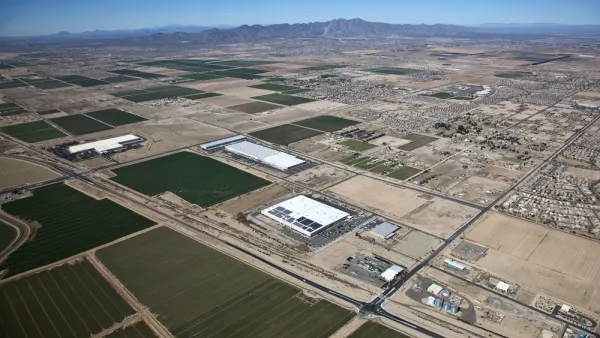
Arizona Tapping Groundwater to Fuel Suburban Growth
Critics say Arizona’s growth patterns are unsustainable and dangerous, given the depleted Colorado River and the state’s deepening reliance on groundwater.

Planetizen Federal Action Tracker
A weekly monitor of how Trump’s orders and actions are impacting planners and planning in America.

Northwest rail fans eager for Sept. 30 debut of Amtrak’s Airo fleet
Get ready for that new train smell and more seats. But they won’t go faster or run more frequently on the Cascades route in Washington and Oregon.
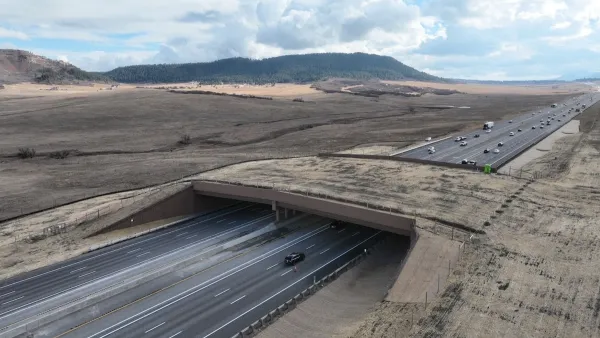
Record-breaking wildlife overpass in Colorado brings 91% reduction in animal collisions
Prior to the overpass, vehicles were hitting one deer per day on Colorado’s Interstate 25.

Detroit to transform waterfront with $2.2 billion investment
Developers will convert about 18 acres of unused parking lot space into civic spaces.

‘Going backwards:’ Baltimore mayor, students rally against state's transit funding plan
Maryland's proposed six-year plan provides no funding for Baltimore’s BMORE bus program and reduces its road maintenance funding.

Trump wants to cancel nearly 98% of funding for HUD housing support program
Multiple housing groups are suing the administration in an effort to preserve the funding.

FREE Course: Walkable City 1: Why Walkability?
After describing his path towards focusing on walkability as the essence of good planning, Jeff Speck marches through his five principal reasons for making more walkable places.
Reinventing Malls: Planning Alchemy—Turning Gray Fields Into Gold
The course focuses on the opportunities and imperatives that shape reinvention of mall sites.

City of Thousand Oaks
City of Wisconsin Rapids
Harvard University Graduate School of Design
The Architects Foundation
University of Cincinnati Online
Northern Illinois Transit Authority (NITA)
The Pocatello Development Authority
The Urban Renewal Agency of the City of Pocatello