Government subsidy programs designed to support the production of the four major food crops are limiting - even penalizing - small farmers' ability to meet regional demand for local fruits and vegetables.


"If you've stood in line at a farmers' market recently, you know that the local food movement is thriving, to the point that small farmers are having a tough time keeping up with the demand.
But consumers who would like to be able to buy local fruits and vegetables not just at farmers' markets, but also in the produce aisle of their supermarket, will be dismayed to learn that the federal government works deliberately and forcefully to prevent the local food movement from expanding. And the barriers that the United States Department of Agriculture has put in place will be extended when the farm bill that House and Senate negotiators are working on now goes into effect.
As a small organic vegetable producer in southern Minnesota, I know this because my efforts to expand production to meet regional demand have been severely hampered by the Agriculture Department's commodity farm program. As I've looked into the politics behind those restrictions, I've come to understand that this is precisely the outcome that the program's backers in California and Florida have in mind: they want to snuff out the local competition before it even gets started."
Thanks to Leslie Pariseau
Read the full story: My Forbidden Fruits (and Vegetables)

Urban Farming Addressing Hunger (and More) in Pittsburgh
Urban farming provides opportunities to increase food security in addition to other benefits.
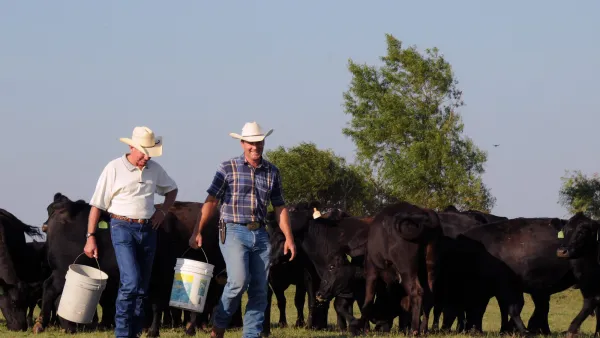
Meeting the Challenge of Feeding 10 Billion People Sustainably in 2050
With world population to grow by about 2 billion by 2050, and with more people eating higher on the food chain as nations develop economically, can world agriculture reduce its carbon footprint? A new World Resources Institute report shows how.
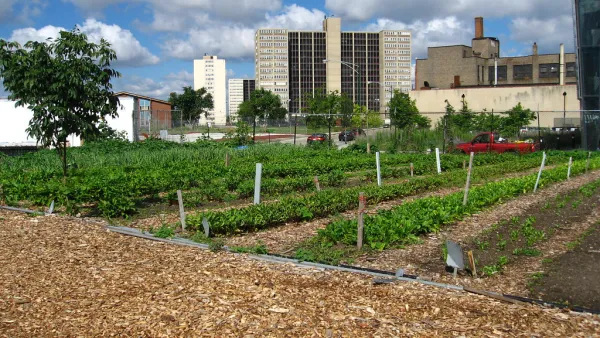
Is This a Way Forward for Urban Farming?
Pulling in community members and a network of local nonprofits, Phoenix's "Spaces of Opportunity" is an attempt to make urban farming something more than a catchphrase.

Planetizen Federal Action Tracker
A weekly monitor of how Trump’s orders and actions are impacting planners and planning in America.

California plans to bury El Niño’s downpour
If the state plays its cards right, it may be able to store a billion acre-feet of El Niño’s water in aquifers.

Desperate measures: Advocates weigh draining Lake Powell to fill Colorado River
Draining the reservoir could reduce evaporation losses by a couple hundred thousand acre-feet.

Mamdani’s pied-à-terre tax survives legal challenge
A panel of judges found that the plaintiffs failed to demonstrate injury as a result of New York City's implementation of the tax.

Eastern Nebraska is running out of electricity
Data centers and electrification are straining eastern Nebraska’s grid, throttling economic development.

Seattle passes record-breaking transit services expansion
Proposition 1 will double the city’s transit tax to add 95,000 more bus trips and preserve 180,000 bus trips annually.

FREE Course: Walkable City 1: Why Walkability?
After describing his path towards focusing on walkability as the essence of good planning, Jeff Speck marches through his five principal reasons for making more walkable places.
Reinventing Malls: Planning Alchemy—Turning Gray Fields Into Gold
The course focuses on the opportunities and imperatives that shape reinvention of mall sites.

City of Rosemead
Rutgers University, Edward J. Bloustein School of Planning and Public Policy
One Hundred Miles
University of Michigan School for Environment and Sustainability (SEAS)
Hunter College, City University of New York (CUNY)
The Architects Foundation
City of Cambridge
Montrose County
The Pocatello Development Authority