Google has replaced current maps of New Orleans with pre-Katrina satellite images on its Google Maps website.


"Scroll across the city and the Mississippi Gulf Coast, and everything is back to normal: Marinas are filled with boats, bridges are intact and parks are filled with healthy, full-bodied trees."
"'Come on,' said an incredulous Ruston Henry, president of the economic development association in New Orleans' devastated Lower 9th Ward."
"Chikai Ohazama, a Google Inc. product manager for satellite imagery, said the maps now available are the best the company can offer. Numerous factors decide what goes into the databases, 'everything from resolution, to quality, to when the actual imagery was acquired.'"
"He said he was not sure when the current images replaced views of the city taken after Katrina struck Aug. 29, 2005, flooding an estimated 80 percent of New Orleans."
"In the images available Thursday, the cranes working to fix the breach of the 17th Street Canal are gone. Blue tarps that covered roofless homes are replaced by shingles. Homes wiped off their foundations are miraculously back in place in the Lower 9th. So, too, is the historic lighthouse on Lake Pontchartrain."
Read the full story: Google Goes Back to Pre-Katrina Maps

Desperate measures: Advocates weigh draining Lake Powell to fill Colorado River
Draining the reservoir could reduce evaporation losses by a couple hundred thousand acre-feet.

Eastern Nebraska is running out of electricity
Data centers and electrification are straining eastern Nebraska’s grid, throttling economic development.
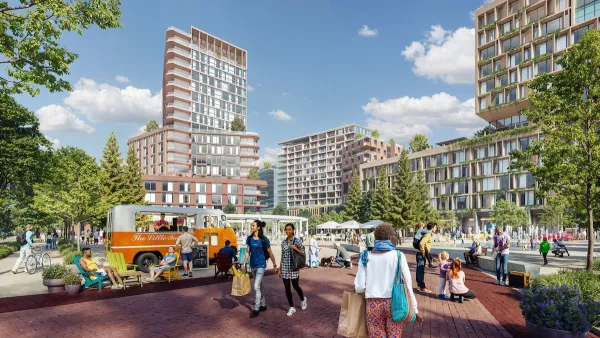
Malls are becoming the midtowns of the future
Mall and office park redevelopments are a generational opportunity to create new nodes of urbanity.

NYC breaks ground on anti-flooding infrastructure project
New York City's new system will reduce stormwater flows to local sewers by 90%.

One Kentucky town’s secret to affordable housing
The Smoketown Community Land Trust has already built seven affordable homes for community members.

Houston gains petal-shaped cooling infrastructure to make streets more ‘delightful’
The city has installed the pavilions along 15 blocks in Houston.

FREE Course: Walkable City 1: Why Walkability?
After describing his path towards focusing on walkability as the essence of good planning, Jeff Speck marches through his five principal reasons for making more walkable places.
Reinventing Malls: Planning Alchemy—Turning Gray Fields Into Gold
The course focuses on the opportunities and imperatives that shape reinvention of mall sites.

City of Rosemead
Rutgers University, Edward J. Bloustein School of Planning and Public Policy
One Hundred Miles
University of Michigan School for Environment and Sustainability (SEAS)
Hunter College, City University of New York (CUNY)
The Architects Foundation
City of Cambridge
Montrose County
The Pocatello Development Authority