California's law to discourage car commuting is rarely followed; many companies breaking the law have never fined.


In 1992, California state lawmakers enacted a law requiring certain employers to pay a monthly stipend to employees who carpool, ride public transit, walk or bike to work. Statewide, only Santa Monica enforces the law. "Under the parking cash-out program, employers must pay a stipend equal to the cost of a parking space to workers who do not drive to the office. The law covers public and private employers that have at least 50 employees and that offer free parking in a leased lot." One Los Angeles area worker chose $185 a month from his employer over free parking; then he bought a $52-a-month bus pass and pocketed the difference.
Martin Wachs, director of the Rand Corp.'s Transportation, Space and Technology Program, believes the cash-out program a good first step. However, he believes that Los Angeles should also limit parking in high rises: "It doesn't make sense to me to spend billions to build subways and the buildings next to them that have seven, eight, ten levels of parking that is provided free to those employees."
The statute includes a $500 fine per vehicle for noncompliance, but not one company has been fined.
Read the full story: Little-Known State Law Gives No-Parking Perk

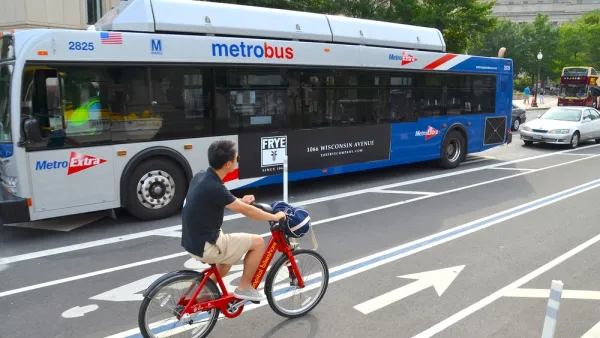
In D.C., Employers Will Refund Workers Who Leave the Car at Home
D.C. has passed a "parking cash-out" law that goes further than a few preexisting examples to reward commuters who leave their cars at home.

Has Anyone at USDOT Read Donald Shoup?
USDOT employees, who are required to go back to the office, will receive free parking at the agency’s D.C. offices — flying in the face of a growing research body that calls for pricing parking at its real value.
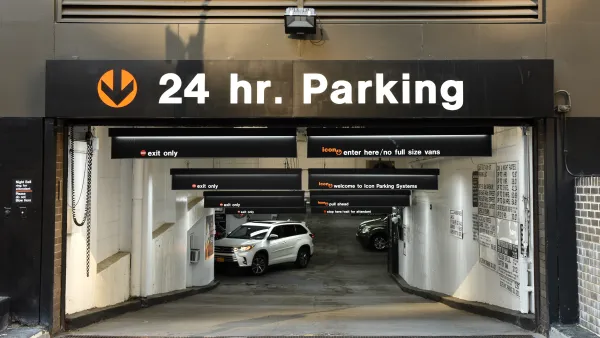
Want to Reduce Traffic Congestion? Cash Out Employer-Paid Parking
Employer-paid parking will undermine New York City’s congestion tolls. But parking cash-out policies like those in California and Washington D.C. can solve the problem.

Planetizen Federal Action Tracker
A weekly monitor of how Trump’s orders and actions are impacting planners and planning in America.

The state-sanctioned urbicide of Austin
People don’t kill cities. Freeways do.

US to reduce Colorado River water deliveries to Mexico
A new Colorado Treaty amendment reduces Mexico’s Colorado River water allocation by 250,000 acre feet.

Nation's most wind-powered state turns to coal as data centers increase energy demand
For the first time in decades, Iowa has increased its generation of coal power.

NYC cools commuters with city's first rain garden above a bus stop
New York City officials say the plants in the rain garden can absorb 16 gallons of rainwater during heavy storms.

Brightline West’s future may rely on $6 billion federal loan
The company has until Nov. 2 to make a $400 million equity investment into its proposed high-speed rail line.

FREE Course: Walkable City 1: Why Walkability?
After describing his path towards focusing on walkability as the essence of good planning, Jeff Speck marches through his five principal reasons for making more walkable places.
Reinventing Malls: Planning Alchemy—Turning Gray Fields Into Gold
The course focuses on the opportunities and imperatives that shape reinvention of mall sites.

Greater Baltimore Committee
Eagle County Government
Harvard University Graduate School of Design
The Architects Foundation
University of Cincinnati Online
The Pocatello Development Authority
The Urban Renewal Agency of the City of Pocatello
Journal of the American Planning Association