The city is examining ways to build more concrete infrastructure without getting entangled in 'decades-long' projects.


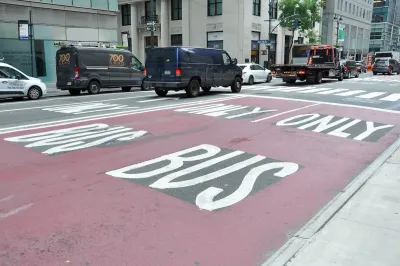
New York City is looking to speed up bike and bus infrastructure installments with “capital-light” projects that are constructed with more solid materials than plastic and paint — which make up the bulk of NYC’s quick turnaround street improvement projects — but that the city can still construct quickly and efficiently.
Department of Transportation Commissioner Mike Flynn talked about the city’s vision at a panel discussion at the 2026 NYC Greenways Summit in Manhattan. Streetsblog reports:
Flynn’s agency hopes to expand its in-house capacity to build more concrete infrastructure without getting bogged down in multi-agency and decades-long projects. “Can we shave two years off a four-year timeline?” Flynn asked. “That would be huge. That’s going to be really key to making our streets the envy of the world.”
Flynn said one way the city could expedite infrastructure upgrades would be through adjusting its street safety work to interfere less with subsurface infrastructure, Kevin Duggan writes for Streetsblog. While city planners often pair concrete roadwork with subsurface work to avoid working on the same road twice, doing so makes the above ground projects take much longer.
Read the full story: DOT Commissioner Floats ‘Capital-Light’ Projects to Speed Up Permanent Street Changes
NYC renovations for dangerous, ‘mercilessly crammed’ street delayed until 2027
Construction was supposed to begin this fall.
NYC votes to cut outdoor dining red tape, speed up permitting
New York City also voted to allow the Department of Transportation to begin work on urgent projects before notifying elected officials.

Data reveals that NYC’s bet on congestion pricing has paid off
After almost two years of the program, reports show positive impacts on traffic and air quality and no disruptions to parking.

Planetizen Federal Action Tracker
A weekly monitor of how Trump’s orders and actions are impacting planners and planning in America.

Eastern Nebraska is running out of electricity
Data centers and electrification are straining eastern Nebraska’s grid, throttling economic development.

Study reveals best places in the U.S. for cycling, walking
New research from Streetlight Data examines bicycle and pedestrian miles per capita in the 100 largest U.S. cities by population.

San Antonio is using environmental review to stall ICE detention center
San Antonio sued last month to pause work on the new detention center until the federal government studied its effect on the surrounding area.

Austin plans light rail extension — before breaking ground on light rail
The planned extension is three miles long and will take riders straight to Austin-Bergstrom International Airport.

Chicago cuts ribbon on $300,000, self-cleaning public toilet
The public toilet is the city’s first, and may pave the way for a rollout of similar facilities.

FREE Course: Walkable City 1: Why Walkability?
After describing his path towards focusing on walkability as the essence of good planning, Jeff Speck marches through his five principal reasons for making more walkable places.
Reinventing Malls: Planning Alchemy—Turning Gray Fields Into Gold
The course focuses on the opportunities and imperatives that shape reinvention of mall sites.

City of Charlotte
City of Rosemead
Rutgers University, Edward J. Bloustein School of Planning and Public Policy
University of Michigan School for Environment and Sustainability (SEAS)
Hunter College, City University of New York (CUNY)
The Architects Foundation
City of Cambridge
The Pocatello Development Authority
The Urban Renewal Agency of the City of Pocatello