Although accessibility regulations look similar in the United States and Canada, our northern neighbors have managed to make planning materials more usable for people with disabilities. Here's what we can learn from them.



Planners across the United States care more about digital accessibility than ever before. New regulations from the Department of Justice codify a longstanding obligation under the Americans with Disabilities Act (ADA) to make online materials accessible. Most states have similar laws covering their activities or local government activities. But beyond regulations, the needs of an aging community and the 20% of Americans who have disabilities also push planners to make their materials usable to help everyone attend meetings, obtain permits and learn about their communities.
Sometimes, when making materials accessible, planners are not sure where to start. I can recommend my courses on digital accessibility for planners, available through Planetizen, for one. But beyond that, there is one place American planners can look: Canada.
Canada’s regulations align with the United States' own accessibility rules. The 2019 Accessible Canada Act mandates digital accessibility in the federal government and federally regulated industries, including transportation and ports. Provinces across Canada (PDF) also have laws that mandate digital accessibility for local governments. Planners are wrestling with many of the same questions as their counterparts in the United States.
And yet – perhaps because these laws are newer and more certain than US regulations – Canadian planners often far exceed their American colleagues in making their digital products accessible.
Three lessons apply to American planners today: avoiding overlays, using simple layouts and prioritizing human help. I will discuss each of these and provide examples from three different provinces in Canada.
- Fewer overlays. Many local governments in the United States use overlays. These are little buttons or add-ons that claim to make a website accessible. Overlays do not work. They are a line of code that changes the user interface but does not do anything for the underlying structure of a site. This structure is what many people with disabilities depend on, especially if they use screen readers. Courts have repeatedly found sites using overlays to be inaccessible. The impulse to add something that promises accessibility is understandable. But adding an overlay is the accessibility equivalent of slapping a sign on a "stroad" and calling the street "bikeable." It does not work.
In my experience, Canadian municipal websites tend to use overlays less often than American ones, avoiding the problems that ensue. Even smaller towns often avoid the use of overlays; for example, West Kelowna, British Columbia (population 37,000) has a fairly accessible website with no overlays. There are many reasons this could be, but I think that the vendors Canadian governments use to build their websites play a role. Canadian municipalities often use a different set of website and digital system vendors from American ones, and it seems these vendors are not pushing overlays. Municipal employees in the United States can take this cue to push back on the use of overlays. - Simpler layouts. It is well-known that U.S. government websites, and especially those related to planning, are complex. Many municipalities use platforms that encourage ever more complicated layouts. This poses a problem for accessibility. Many people cannot navigate these sites, and many more things are likely to go wrong on a complex site. It is why I often start accessibility training with a reminder to "keep things simple."
Canada tends to heed this lesson a little more. Many Canadian government and planning-related sites are far simpler than their U.S. counterparts. One example I often point to – and that I use in Digital Accessibility for Planners – is the municipal website for Ottawa. Though perhaps not as "engaging" as many American sites, it is very simply and effectively laid out – and extremely accessible, too. - Human help. People with disabilities, like anyone else, may have questions. Sometimes people with disabilities have specific access needs. Often, these needs are fairly obscure and not well covered by FAQs or by the predictive — and often inaccurate — outputs of chatbots. These needs also matter whether or not a website is accessible. For this reason, international standard bodies encourage organizations to provide human help whenever possible. This help should be easy to access, yet it can be vanishingly hard to find on many American public sector websites.
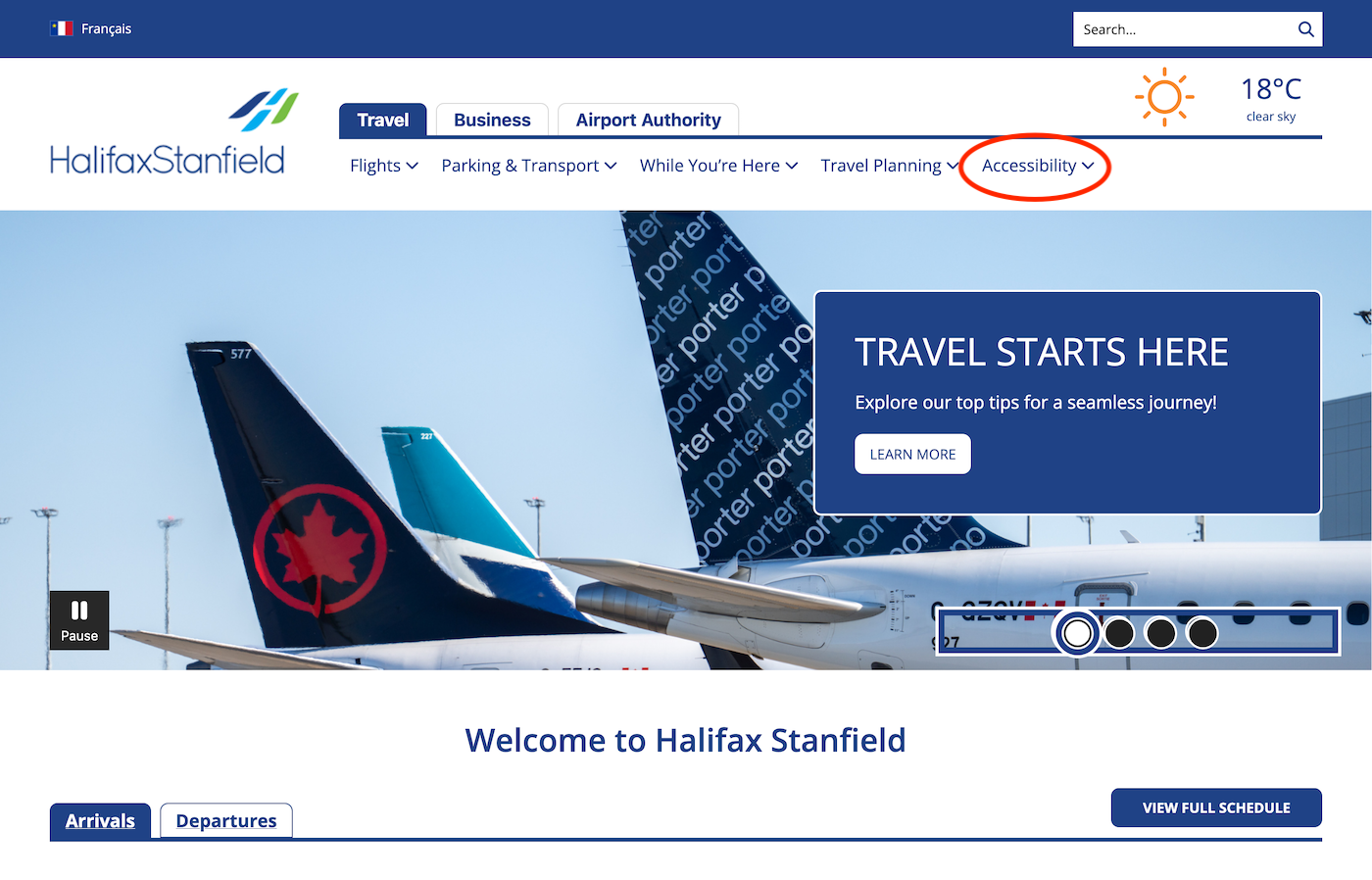
I often find myself, when working with clients here in the United States, drawing on Canadian examples of providing human help. Many Canadian organizations offer ways to get human help prominently on their home pages, with detailed information and avenues for contact. One of my favorite examples is Halifax’s main international gateway, Stanfield Airport, which has an accessibility page linked on its main navigation bar. This prioritization of human help is now even in Canada’s new national standard on accessible service delivery.
As Americans, we frequently tend not to look beyond our borders – and when we do, we look across the Atlantic. Yet many of the best lessons for digital accessibility, and examples of what good accessibility looks like, can be found closer to home with our northern neighbors. I hope you learn from them.
—
Jonathan Katz-Ouziel is an autistic planner, an independent accessibility consultant, and the founder of Opossum House Accessibility. He holds a decade of experience in ensuring compliance with accessibility regulations and helping public and private organizations include and support people with disabilities.


Amtrak makes over 160 stations fully accessible
Upgrades include new elevators, signage and accessible restrooms.

Commentary: LA’s ‘Large Asphalt Repair’ Policy Privileges Drivers, Endangers Others
A new policy to perform spot repairs rather than resurfacing entire streets lets the city skirt requirements to install accessibility and pedestrian infrastructure.
Denver Advocates Sue RTD for Charging People With Disabilities for On-demand Transit
The suit argues the agency is violating the rights of Americans with disabilities while lowering fares for other riders.

Planetizen Federal Action Tracker
A weekly monitor of how Trump’s orders and actions are impacting planners and planning in America.

California plans to bury El Niño’s downpour
If the state plays its cards right, it may be able to store a billion acre-feet of El Niño’s water in aquifers.

Chicago breaks ground on $3 billion megadevelopment
The new neighborhood, titled Foundry Park, will one day host 3,700 residences.

Want to study the Missouri River? Soon, you may need unanimous approval from 10 states
Legislation would require 10 governors’ permission to study or build projects moving water outside the basin.

Desperate measures: Advocates weigh draining Lake Powell to fill Colorado River
Draining the reservoir could reduce evaporation losses by a couple hundred thousand acre-feet.

This road in NYC is infamously dangerous — and Mamdani can't fix it
New York City's Ocean Parkway is known for reckless driving, but the power to implement safety measures lies with the state rather than the city.

FREE Course: Walkable City 1: Why Walkability?
After describing his path towards focusing on walkability as the essence of good planning, Jeff Speck marches through his five principal reasons for making more walkable places.
Reinventing Malls: Planning Alchemy—Turning Gray Fields Into Gold
The course focuses on the opportunities and imperatives that shape reinvention of mall sites.

City of Rosemead
Rutgers University, Edward J. Bloustein School of Planning and Public Policy
One Hundred Miles
Hunter College, City University of New York (CUNY)
The Architects Foundation
University of Cincinnati Online
City of Cambridge
Montrose County
The Pocatello Development Authority

