The MCTS system will have to make a difficult choice between service frequency and coverage.



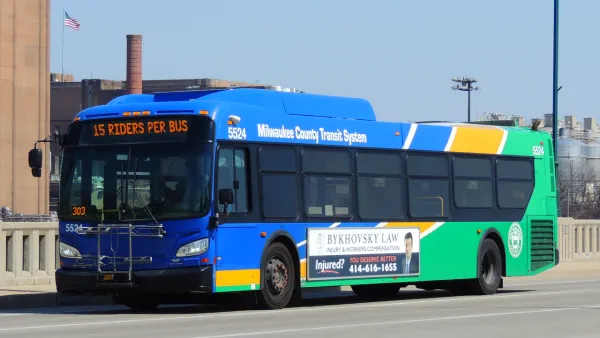
The Milwaukee County Transit System announced plans to reduce service by 25% to stabilize its finances so it can sustain itself for the next three years without additional funding.
As Graham Kilmer explains in Urban Milwaukee, "During those three years, the system will finish and implement a generational redesign of the bus network and carry out a campaign 'trying aggressively to find dedicated funding,'" said MCTS President and CEO Steve Fuentes.
The agency plans to make "drastic" changes to its bus system one way or another due to a budget gap of $9.3 million, Kilmer adds. "Under existing budget conditions, the system cannot have both high-ridership, high-frequency service and extensive geographic coverage, Ricky Angueira, a principal associate from JWA helping MCTS with the redesign, said." Ultimately, MCTS has to decide between coverage and frequency — a question Fuentes says will be decided over the next few months.
Read the full story: Bus System Plans 25% Service Cut

Postponed Milwaukee BRT Project at Least a Decade Away
The county’s transit system won’t pursue a second rapid bus line due to financial constraints.

BART Service Cuts, Station Closures Could ‘Set Back the System 50 Years’
The agency could close dozens of stations and eliminate the Blue line between Daly City and Dublin-Pleasanton entirely.

Portland Transit is About to Get a Lot Worse
TriMet is making multiple rounds of service cuts this year as the agency faces a $300 million budget shortfall.

Planetizen Federal Action Tracker
A weekly monitor of how Trump’s orders and actions are impacting planners and planning in America.

Data reveals that NYC’s bet on congestion pricing has paid off
After almost two years of the program, reports show positive impacts on traffic and air quality and no disruptions to parking.

HUD modernizes 50-year-old manufactured housing framework
The Next Generation Manufactured Housing Action Plan establishes new energy-efficiency standards for manufactured homes, and new guidelines for anchoring them.

Florida could lose billions in funding for infrastructure, parks
If Amendment 3 passes, Miami-Dade would lose about $445 million annually by fiscal year 2028-29.

New Mexico spent millions drafting climate goals. Data centers are unraveling them
Three data centers in New Mexico and El Paso will release more emissions yearly than 2 million cars in the same timeframe.

This Ohio town is using AI to speed up transit analysis
The Greater Dayton Regional Transit Authority’s new AI tool correctly determined riders’ preferred ways to reach key commuter routes.

FREE Course: Walkable City 1: Why Walkability?
After describing his path towards focusing on walkability as the essence of good planning, Jeff Speck marches through his five principal reasons for making more walkable places.
Reinventing Malls: Planning Alchemy—Turning Gray Fields Into Gold
The course focuses on the opportunities and imperatives that shape reinvention of mall sites.


Rutgers University, Edward J. Bloustein School of Planning and Public Policy
One Hundred Miles
County of Mendocino
The Architects Foundation
University of Cincinnati Online
Montrose County
Northern Illinois Transit Authority (NITA)
The Pocatello Development Authority